
Why GRC Analysts Are Getting Stuck in 2026 .. And GRC Engineers Aren’t
The Career Cost of Staying in Reporting-Only GRC

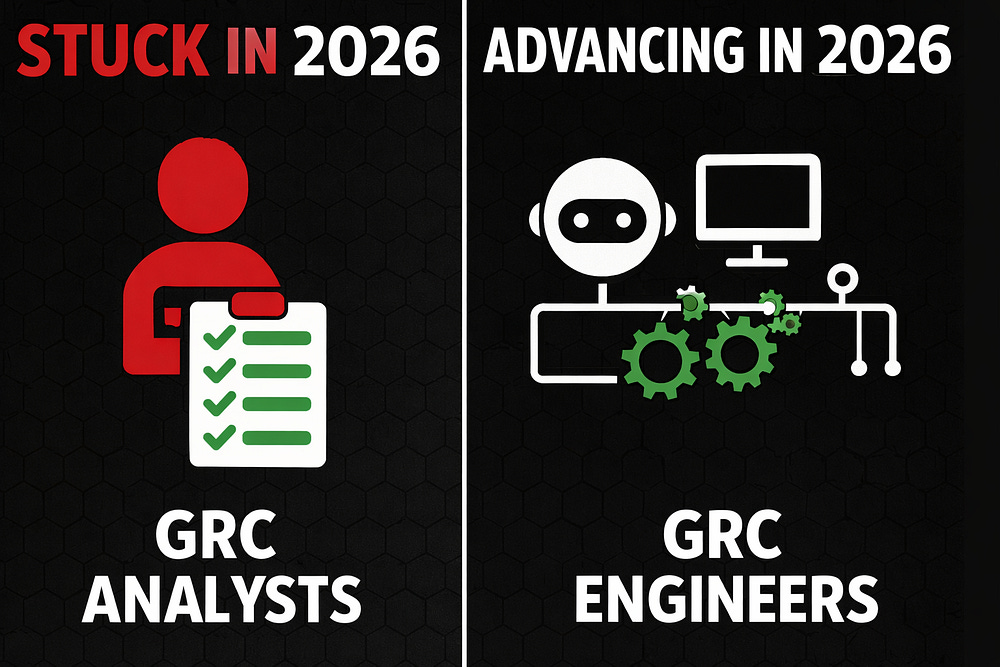
In 2026, the problem with many GRC careers will not be lack of knowledge.
It is going to be lack of leverage.
Most GRC Analysts know the frameworks.
They understand ISO 27001, SOC 2, NIST, PCI, GDPR, NIS2.
They can write policies, conduct interviews, collect screenshots, and prepare audit packs.
Yet many of them feel stuck.
Same title. Same pay band. Same cycle of audits. Same stress every quarter.
Meanwhile, a smaller but growing group — GRC Engineers — are moving faster, earning more, and being pulled into strategic conversations that traditional analysts rarely touch.
This isn’t about elitism. It’s about how the work maps to how companies operate in 2026.
The Core Difference Isn’t Skill — It’s Output
The cleanest way to understand the divide is this:
Most GRC Analysts still produce reports. These reports describe risk, summarize compliance status, and present findings in a format executives and auditors recognize. That work is legitimate and often required. But it is descriptive by nature. It explains what the environment looks like at a moment in time.
GRC Engineers, by contrast, produce systems. Their work changes how environments behave. Instead of describing whether controls are working, they design controls so that non-compliance becomes difficult or impossible by default. This single distinction has massive career implications.
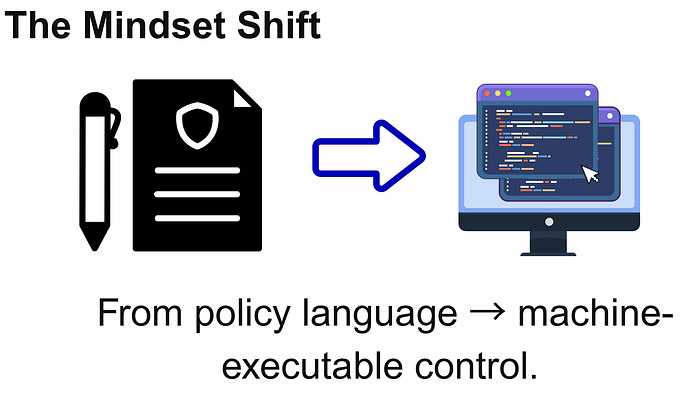
Both roles may “do GRC.”
But only one produces outcomes that scale.
What GRC Analysts Typically Deliver
In most organizations, the GRC Analyst’s output looks like this:
Risk registers in spreadsheets or GRC tools
Control matrices mapped to frameworks
Audit evidence gathered manually
Policy documents reviewed annually
Status reports showing “green / amber / red”
This work is valuable — but it is descriptive, not operational.
It tells the organization what the risk posture looks like. It does not change how the system behaves.
And in 2026, that distinction matters more than ever.
Why GRC Analyst Careers Are Stalling in 2026
1. Reporting Is No Longer a Differentiator
Executives don’t struggle to get reports anymore.
Dashboards are everywhere:
Cloud security platforms
CSP native tools
Compliance modules
AI-generated summaries
What they struggle with is control reliability.
They don’t want to know
“Are we compliant?”
They want to know:
“Will this control still work at 3am when something breaks?”
Traditional GRC roles rarely answer that question.
2. Evidence Collection Is Being Automated Away
In 2026:
Screenshots are a red flag
Manual sampling is questioned
Annual evidence is considered weak assurance
Auditors increasingly expect:
System-generated evidence
Continuous logs
Config state validation
Time-bound, tamper-resistant proof
When your core value is collecting evidence, and evidence becomes automated, your role becomes fragile.
That’s not a personal failure — it’s a structural one.
3. Analysts Are Cost Centers — Engineers Become Multipliers
From a budget perspective:
A GRC Analyst scales linearly
(More scope = more people)A GRC Engineer scales exponentially
(More scope = more automation)
In tight economic conditions — which 2026 still is — this distinction decides who gets hired, promoted, or cut.
What GRC Engineers Do Differently
GRC Engineers don’t abandon governance.
They embed it into systems.
Instead of asking:
“Do we have evidence for this control?”
They design environments where
“Evidence is produced automatically because the control cannot operate any other way.”
Their Core Outputs Look Like This:
Policy-as-code
Control validation pipelines
Continuous compliance checks
Automated evidence generation
Guardrails baked into infrastructure
This changes the conversation entirely.
Reporting vs Pipelines: A Concrete Example
GRC Analyst Approach
For an access control requirement, the analyst might:
Review IAM policies quarterly
Sample user access
Capture screenshots
Document exceptions
Write a finding
Outcome:
Risk identified
Remediation requested
Repeat next quarter
GRC Engineer Approach
The engineer might:
Enforce IAM guardrails via code
Block non-compliant policies automatically
Log every access change
Generate evidence continuously
Alert on drift in real time
Outcome:
Risk prevented
Evidence always available
Audit becomes a byproduct, not a project
One role explains risk. The other removes it.
Why GRC Engineers Advance Faster
Because they work closer to delivery teams, GRC Engineers are involved earlier in decisions.
They help design secure architectures instead of reviewing them afterward. That proximity builds trust and visibility, which naturally leads to influence.
Their work is also more resilient to AI automation.
While AI can draft policies, map controls, and summarize risk, it struggles to design environment-specific governance systems.
Engineering enforceable controls still requires judgment, trade-off analysis, and deep understanding of how systems behave under stress.
Perhaps most importantly, GRC Engineers build portable career capital.
Pipelines, frameworks, and automation patterns travel well between organizations. Documentation and tool-specific workflows often don’t.
The Emerging Pay and Opportunity Gap
None of this is theoretical anymore. By 2026, pay gaps are already visible.
Senior GRC Analyst roles plateau quickly, while hybrid governance-engineering roles continue to command premiums.
The market isn’t devaluing governance — it’s re-pricing execution.
Organizations don’t just want assurance that controls exist. They want confidence that controls cannot quietly fail.
This Isn’t an Attack on Analysts — It’s a Reality Check
GRC Analysts aren’t doing bad work. They’re operating in a model built for a slower, more static world.
But the environment has changed. Cloud, AI, and continuous delivery have made governance a systems problem, not a documentation problem.
In 2026, the most important question for a GRC professional isn’t what framework they know.
It’s whether their work changes how systems behave when no one is watching.
That’s the line separating careers that stall from careers that compound.
Thanks for reading this !
If you are interested in learning more about GRC Engineering then check out my course HERE
if you are a paid subscriber then you get access to it for free . Just use the voucher below ( it expires 31st December 2025 so be sure to get is quick ! )
