
This is How I Passed the AWS Security Specialty Certification In Jan 2026
Another year, another certification milestone.

I’ve just renewed my AWS Certified Security — Specialty, and it felt like a good moment to revisit this article I originally wrote back in 2023.
Not just to say “I passed again”, but to reflect on how the exam itself has evolved — and why passing it today requires a much deeper understanding of AWS security architecture than before.
This isn’t a motivational post about certifications being magical career boosters. I’ve never believed that.
But this is a practical update on what the exam now expects — and how you should think if you want to pass it.
Why I Took (and Renewed) the AWS Security Specialty
My reasons haven’t changed much:
I work in AWS, so certifications need to stay current
I work in cloud security, and it would be strange not to hold AWS’s flagship security cert
But what has changed is how much closer this exam now feels to real-world security work.
AWS has deliberately pushed the exam away from surface-level service knowledge and toward architecture, trade-offs, and operational decision-making.
About the AWS Security Specialty Certification
This is not a beginner certification.
AWS describes it as being intended for individuals who perform a security role and have at least 3 to 5 years of hands-on experience securing AWS workloads — and that description is accurate.
The exam has also undergone a refresh (SCS-C03) with the current version more aligned with the evolving security landscape.
This means that while the exam still tests classic AWS security mechanics, it now expects candidates to think about security holistically — from identity policies and secure data design to detection, response, and governance.
The domains are broadly familiar — identity, infrastructure security, detection, incident response, and data protection — but the depth within those domains has increased noticeably.
This is not an exam you can pass by memorizing service descriptions.
My Experience with the updated Exam
Compared to earlier versions, the current iteration of the exam feels far more architecture-centric.
You’re expected to understand:
How security services work together
Where controls overlap
Why you would choose one service over another
1 — IAM Is Now Absolutely Central
When I first wrote about this certification in 2023, one of my core prep tips was to deep dive into IAM — not just superficially understand it, but master how policies are constructed, evaluated, and enforced. That advice is even more relevant now:
IAM now represents 20% of the scored content, up from 16% previously, reflecting its central role in cloud security.
The exam tests not only basic permissions but architectural thinking — like designing least-privilege access models, using IAM Identity Center, temporary creds, and ABAC/RBAC strategies.
IAM isn’t just a checkbox; it’s the backbone of secure architectures. Understanding how IAM interacts with roles, trust policies, resource policies, STS, and cross-account access is essential for passing the exam
2 — Security Groups and NACLs Are Tested as Architecture Controls
Another noticeable shift is how network security primitives are tested.
You’re not just asked what a Security Group or NACL is. You’re expected to understand how and why you would layer them together
These controls are tested as part of an overall security architecture, not as standalone trivia.
3 — Trade-Offs Matter More Than Ever
One of the hardest parts of the exam now is that AWS expects you to reason about trade-offs such as:
Simplicity vs. control
Cost vs. depth of inspection
Operational overhead vs. security benefit
Centralised controls vs. workload-level enforcement
You’re being tested on whether you can design something that would actually work in production — not just something that looks secure on paper.
4 — Understand the Exam Question Types
The way in which the exam structures questions is a major part of the difficulty especially the multiple response ones which have two or more correct answers and the ordering ones .. where you have to place answers in the correct sequence.
The trap is over-selecting answers that are “technically true” but unnecessary or misaligned with the scenario. AWS is testing whether you can identify the correct set, not everything that could work.
How I Prepared (What Still Works)
Much of my original preparation advice still holds.
1 — Build a Proper Foundation
If this is your first AWS certification, I still strongly recommend doing Solutions Architect — Associate first. The Security Specialty assumes you already speak AWS fluently. Do NOT jump into AWS Security Specialty if this is your first time learning AWS
2 — Get Hands-On
You cannot pass this exam without real AWS experience. Get an AWS Free Tier Account and set up:
IAM policies
Roles and cross-account access
Logging with CloudTrail and CloudWatch
Encryption with KMS
Network controls with Security Groups and NACLs
Reading alone is not enough.
3 — Training and Practice Exams
Structured training helps, but practice exams are essential. They teach you how AWS frames questions — which is half the battle.
4 — Whitepapers and Labs
AWS whitepapers and Well-Architected labs remain excellent, especially for understanding intent rather than memorisation.
Did I Pass?
Yes — again.
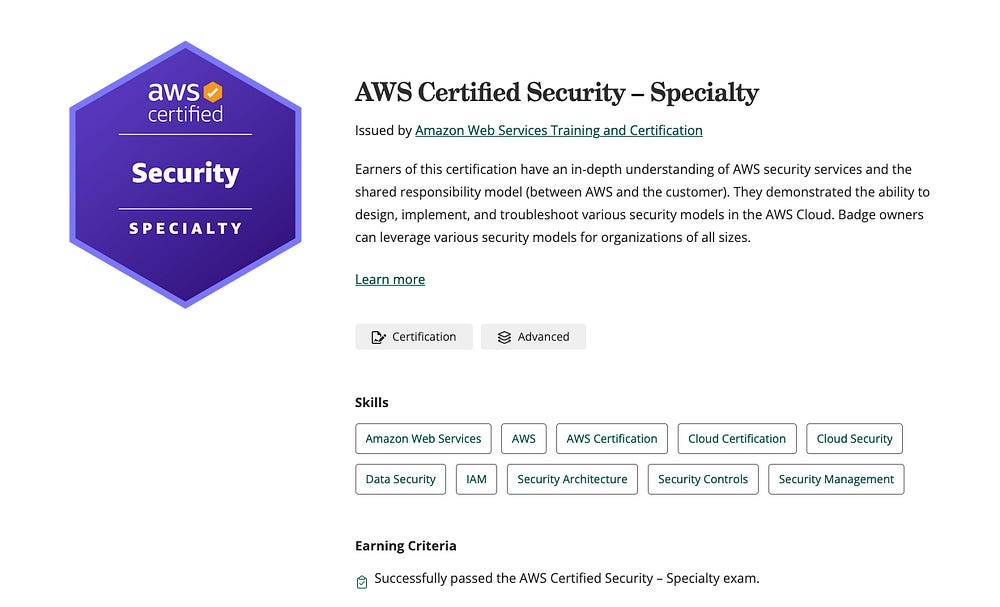
But more importantly, this renewal reinforced something I’ve believed for years: This exam is valuable not because of the badge, but because of how closely it now mirrors real cloud security decision-making.
Final Thoughts
The AWS Security Specialty exam is not easy — and it’s not supposed to be.
It rewards a good understanding over memorisation and an architecture mindset over service trivia
If you approach it as an exercise in learning how AWS security actually works in production, you’ll not only pass — you’ll become a much stronger cloud security practitioner in the process.
Good luck to anyone preparing for it.
I want this certification also please help with the link. My email address is Pmalakata@gmail.com
After weeks of prep, I finally cleared the SCS-C03 exam and all the credit goes to Certs4Future. They providing not just questions, but also clarity with each explanation.