
The Cybersecurity Engineer of 2030 Will Look Nothing Like Today’s
The death of the Human API in Cybersecurity

Good news .. If you’re a cybersecurity engineer right now, your job will almost certainly still exist in 2030. What probably won’t survive is the way you do it .. and that’s the part most people miss when they worry about AI.
The fear is usually framed as replacement: the machine takes the job. I think that’s the wrong worry. The real shift is quieter and harder to plan for. AI isn’t going to delete the security engineer so much as quietly rewrite the job description while the title stays the same.
And a lot of people are preparing diligently for the wrong version of the future .. stacking up tools, certifications, and product knowledge for a role that’s already changing underneath them.
What the job looks like today
Walk into most security teams and you’ll find engineers spending their weeks on a familiar rotation: triaging alerts, writing scripts, updating documentation, investigating incidents, building reports, reviewing configurations and pull requests, closing tickets, assessing vulnerabilities, running security reviews. Plenty of that work genuinely matters. A lot of it is also repetitive, and for years the industry treated that repetition as a hiring problem .. when the workload grew, you added headcount to absorb it.
That assumption is the thing quietly breaking. Agentic AI, coding assistants, and increasingly capable models mean a large share of that rotation can now be done faster, or handed off to software entirely. So when the workload climbs, the question a security leader asks is no longer automatically “how many more engineers do we need?” It’s “do we need more people, or do we need better workflows?” Once that question gets asked seriously, a lot of things change.
The death of the human API
A surprising number of security engineers function, without ever naming it, as human APIs. A developer needs a security review, so they file a ticket and wait. An engineer picks it up, reads the code, writes back a set of recommendations, and the queue advances by one. Do that a few thousand times and you have a career. The engineer in that loop is essentially a routing mechanism for security knowledge .. a slow, expensive lookup service with a backlog.
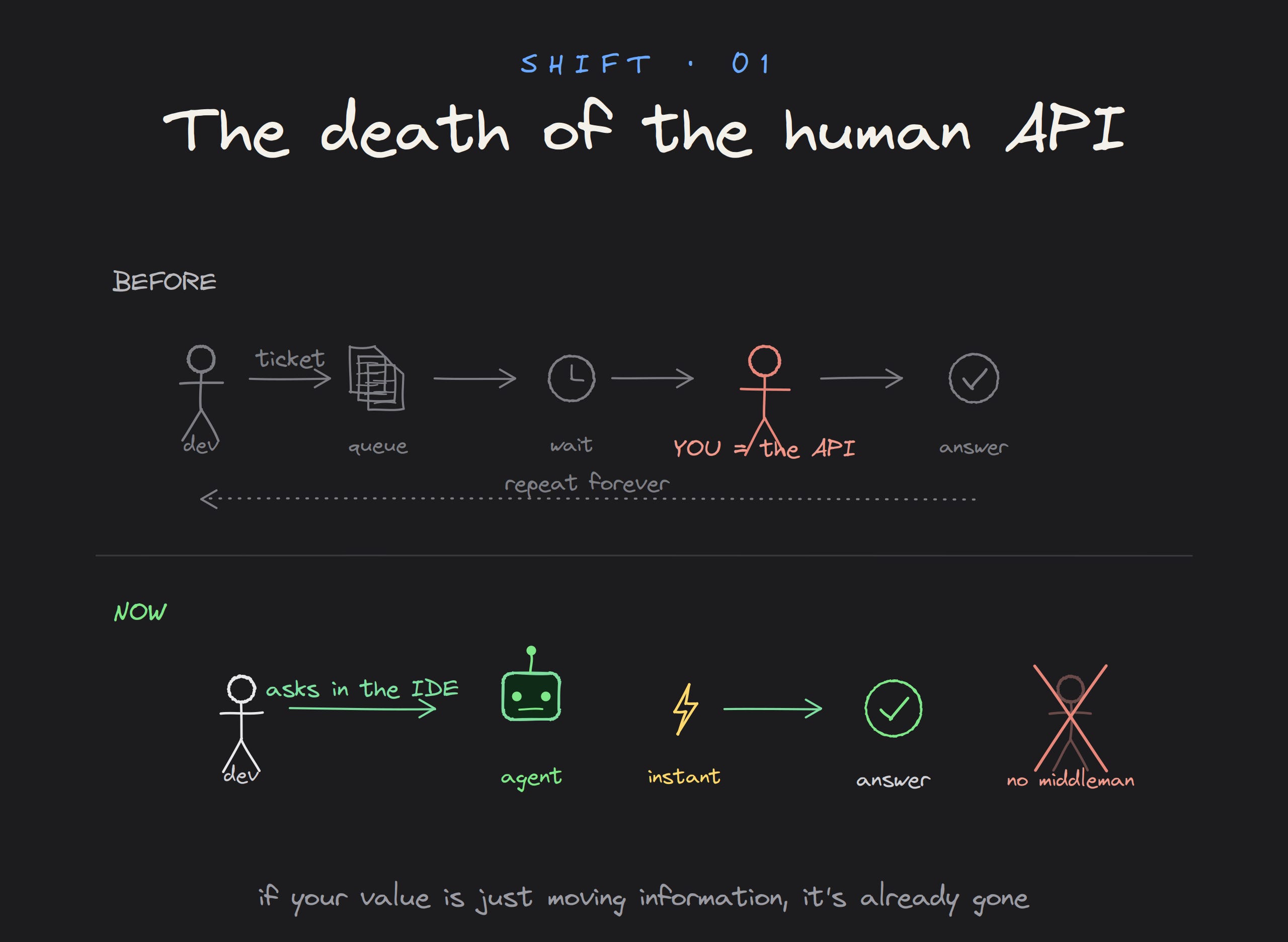
That is precisely the kind of work AI has gotten good at. It can answer the question, review the code, flag the misconfiguration, draft the policy, summarize the incident, and produce a first-pass threat model — instantly, and increasingly inside the developer’s editor rather than at the end of a ticket queue. None of this eliminates security engineers as a profession. What it eliminates is the narrow version of the role whose entire value was being a human bottleneck in front of information the machine can now hand over directly.
This future is already arriving
If that still sounds like speculation, look at what AWS shipped in June 2026.
At its New York summit, AWS introduced Continuum, an AI-native security platform built around a phrase the company keeps repeating: security at machine speed. The product itself matters less than what it reveals about where the whole industry is being pulled. For a decade, security teams have run on one basic operating model .. collect telemetry, store it, build dashboards, review findings, prioritize, investigate, validate, recommend a fix, track the remediation, repeat. AWS’s argument is blunt: that model can no longer keep up, partly because frontier models in the hands of attackers are finding and chaining vulnerabilities faster than any human backlog can absorb.
Continuum, currently in gated preview, is designed to work the full lifecycle of a code vulnerability on its own. It ingests your existing backlog and runs its own scans, prioritizes each finding against the business context of your environment, proves which vulnerabilities are actually exploitable by building reproducible exploits in a sandbox, then recommends and validates fixes with blast-radius visibility and a rollback path. Folded into it are the threat-modeling and code-scanning capabilities AWS previewed at re:Invent the winter before — including automatic generation of STRIDE threat models straight from design documents or source code, wired into AI development environments like Claude Code and Kiro.
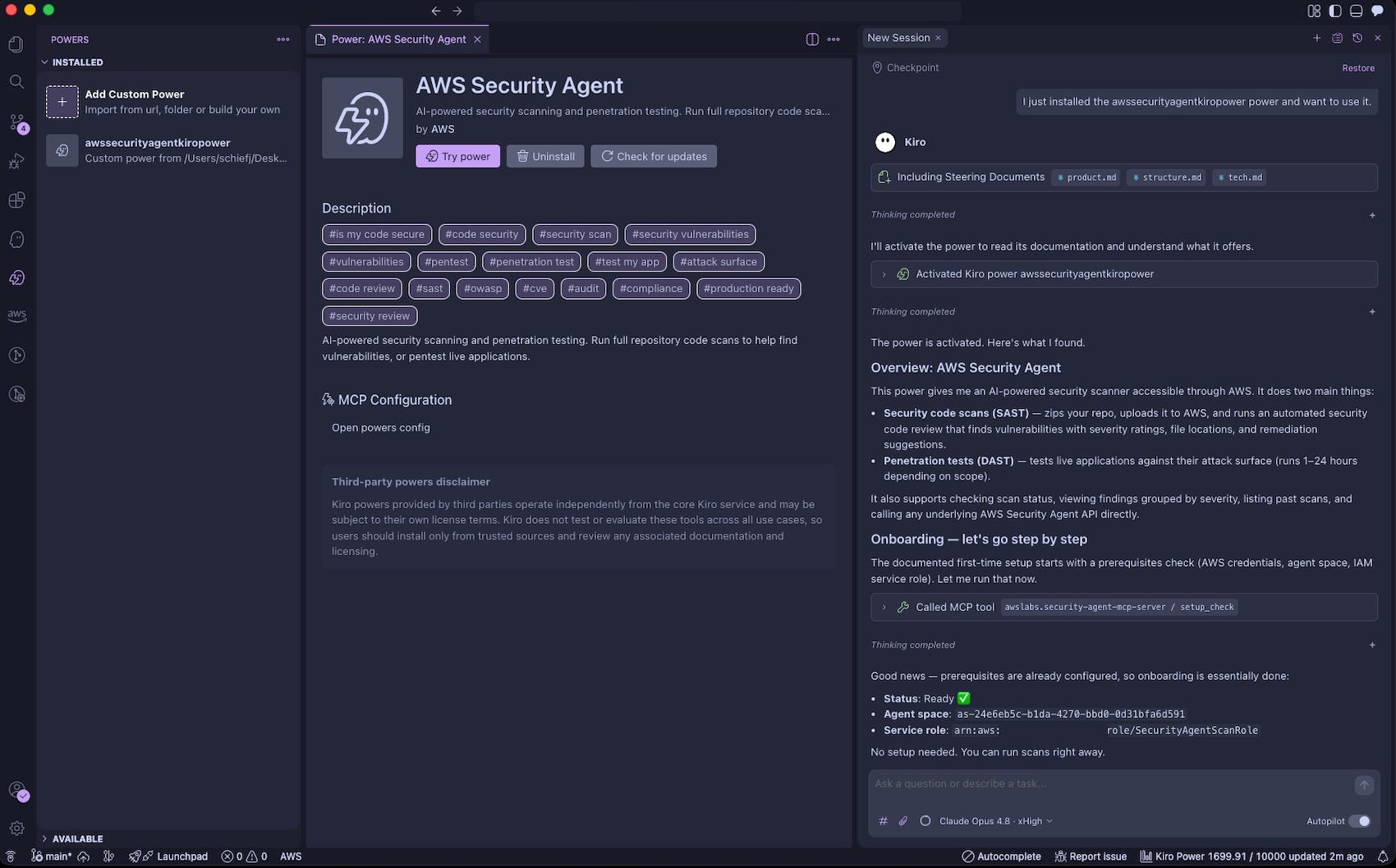
Sit with that for a second, because it’s a list of things security engineers have spent entire careers doing. AWS isn’t building a tool to help an engineer get through more tickets. It’s building a system meant to reduce how many tickets reach a human at all. And it ships with a “graduated trust” model that tells you exactly where this is going: Continuum starts in a learn mode with a human reviewing every recommendation and its reasoning, then graduates to an enforce mode where it remediates automatically within the risk categories you’ve defined. The human moves from doing the work to setting the boundaries the work runs inside.
The cleanest summary of the shift came from AWS itself, describing the move from one mental model — telemetry, storage, queries, dashboards — to another: telemetry, context, reasoning, actions. That second sequence is, almost word for word, a description of where the security engineer’s own job is heading. Less manual analysis, more judgment about what the analysis should mean and what to do about it. The biggest technology companies in the world are now spending real money on the assumption that this is the future. The open question is whether the average security engineer is preparing for the same future, or for an industry that’s quietly being dismantled around them.
What organizations will actually need
As more of the execution gets automated, the premium moves to the work that resists automation — and that work is judgment. The valuable questions in 2030 aren’t “how do I write this detection rule” or “is this finding a false positive.” They’re the ambiguous ones: Should we deploy this AI system at all? How much risk are we actually willing to carry here? Which controls are worth the money, and which are theater? Of these thousand findings, which handful genuinely matters? What trade-offs can this particular business live with?
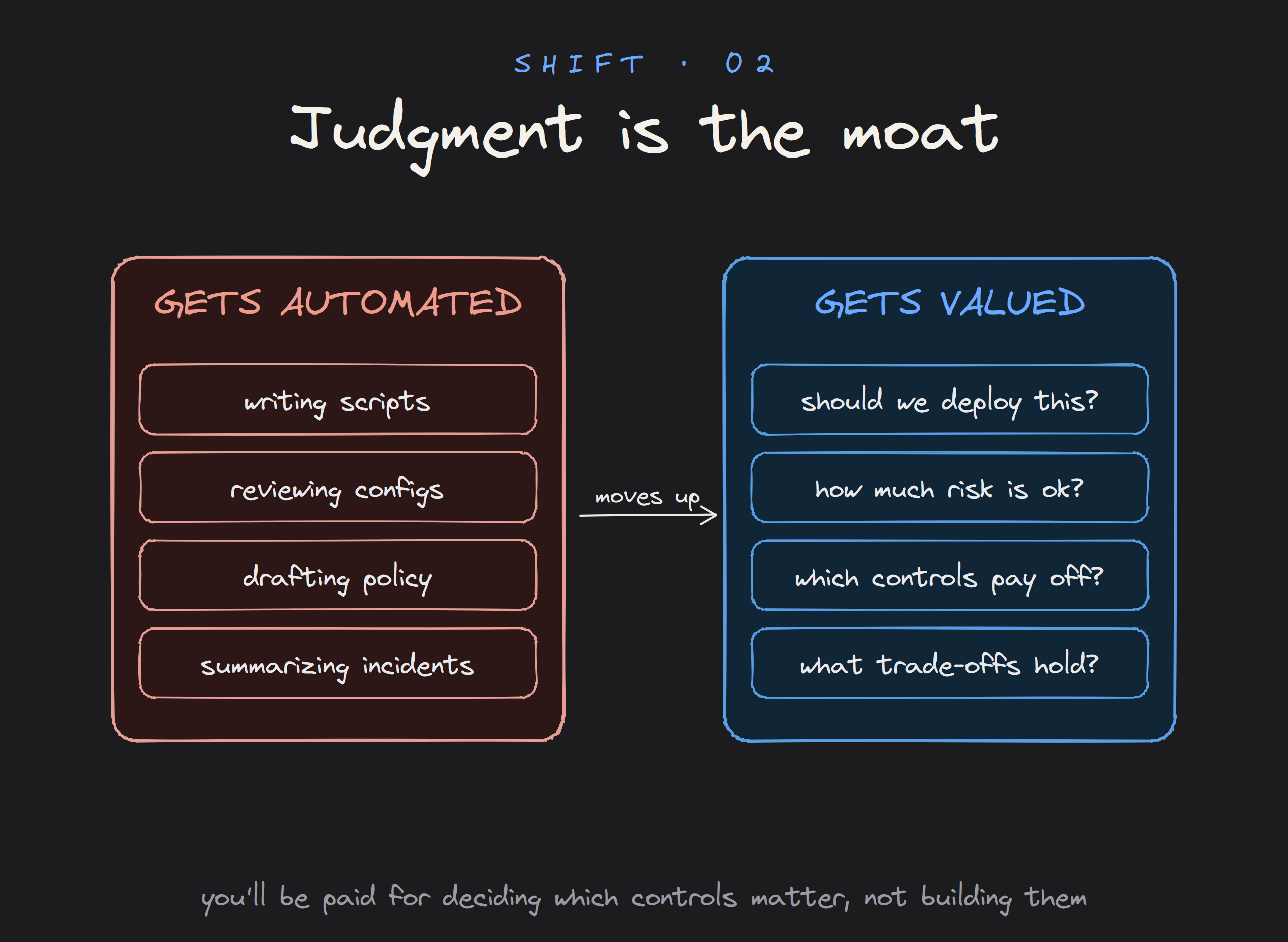
None of those are really technical questions. They’re judgment calls that depend on context a model doesn’t have, and judgment has proven stubbornly hard to automate. The security engineer of 2030 will spend less time implementing controls and a lot more time deciding which controls deserve to exist.
The line between engineer and architect disappears
For most of the field’s history, architecture was the senior tier. Engineers built the systems; architects designed them; you earned your way from one to the other. AI is collapsing that distinction faster than most career ladders can adapt. When a model can generate the scripts, the infrastructure templates, the detection logic, and the documentation, the scarce and valuable skill stops being the building and becomes the deciding how it should be built.
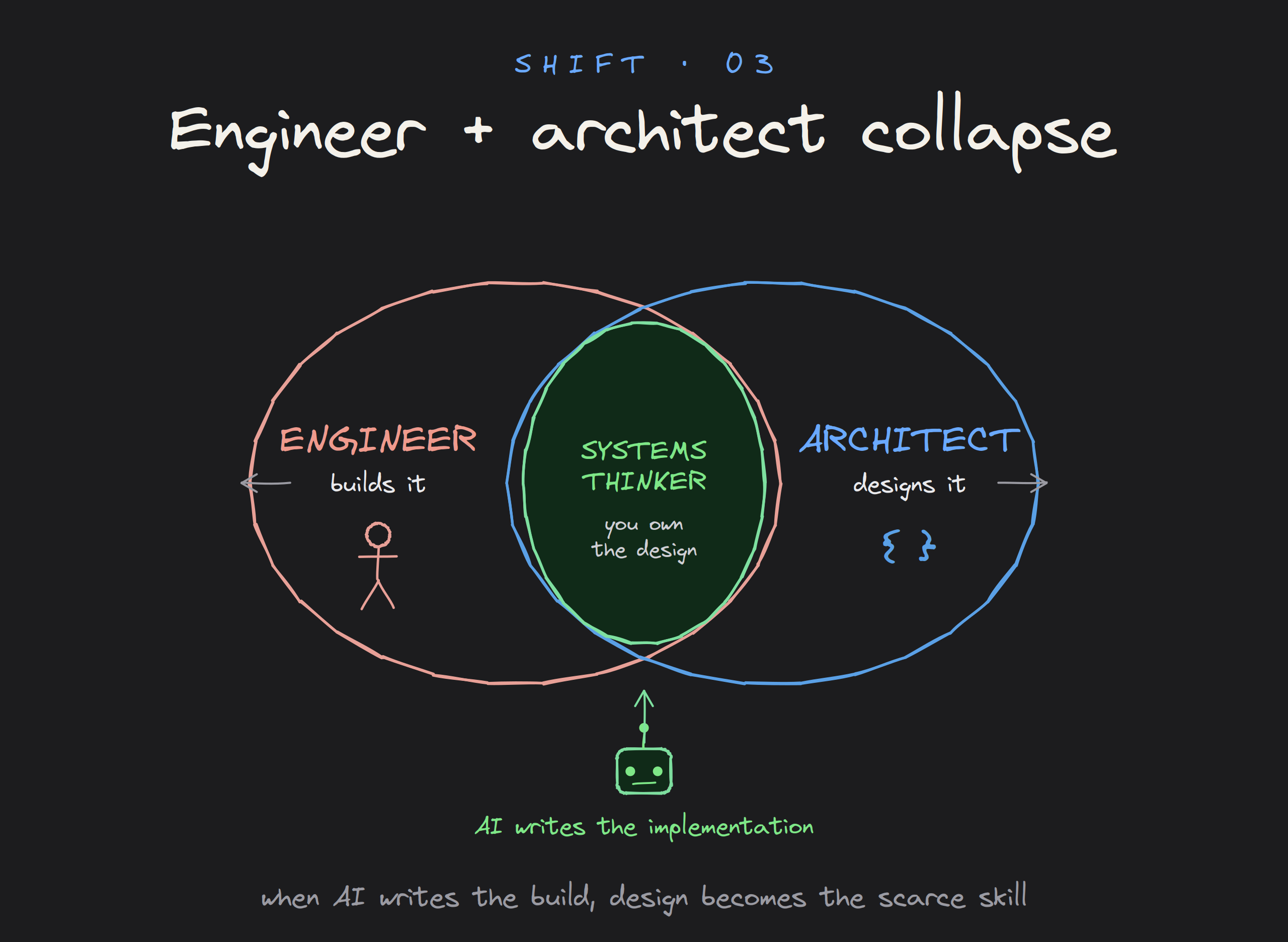
That pushes every engineer toward thinking at the level architects used to own: cloud and AI-agent architecture, identity systems, data flows, trust boundaries, the business processes the whole thing exists to serve. Organizations will need fewer people who can configure a specific tool and more who understand how a sprawling, half-autonomous system actually fits together — and where it break
AI becomes a teammate, not a tool you reach for
Most engineers today treat AI as something they occasionally open in another tab. That’s already turning into something structural. The near future looks like a security engineer working alongside several specialized agents at once : one combing through logs, one reviewing infrastructure changes, one researching vulnerabilities, one drafting documentation, one continuously mapping attack paths. AWS just shipped a version of exactly this; it won’t be the last.
In that world the job shifts from doing each task to directing the things that do them .. deciding what to delegate, checking the output, setting the guardrails, and stepping in when an autonomous action needs a human’s judgment. It’s a genuinely different skill set, and it’s worth being honest that the best security engineer of 2030 may not be the strongest coder in the room. They’ll be the best coordinator — the person who can break a problem apart, hand the pieces to the right agents, and stay accountable for the result.
The skill almost nobody is investing in
Here’s the trend that gets the least attention and may end up mattering most. As the technical work gets cheaper to automate, communication becomes the bottleneck. Most organizations don’t fail for lack of security tooling .. they’re drowning in it. They fail because the security team can’t translate risk into something leadership will actually act on.
So the future engineer spends more time influencing stakeholders, explaining risk in business terms, arguing for where the money should go, guiding engineering teams, and turning findings into decisions. An AI can explain a vulnerability flawlessly. It cannot read the politics in a room, build trust with a skeptical VP of engineering, or talk a CFO into funding a remediation that competes with everything else on the budget. That part stays human, and it gets more valuable, not less.
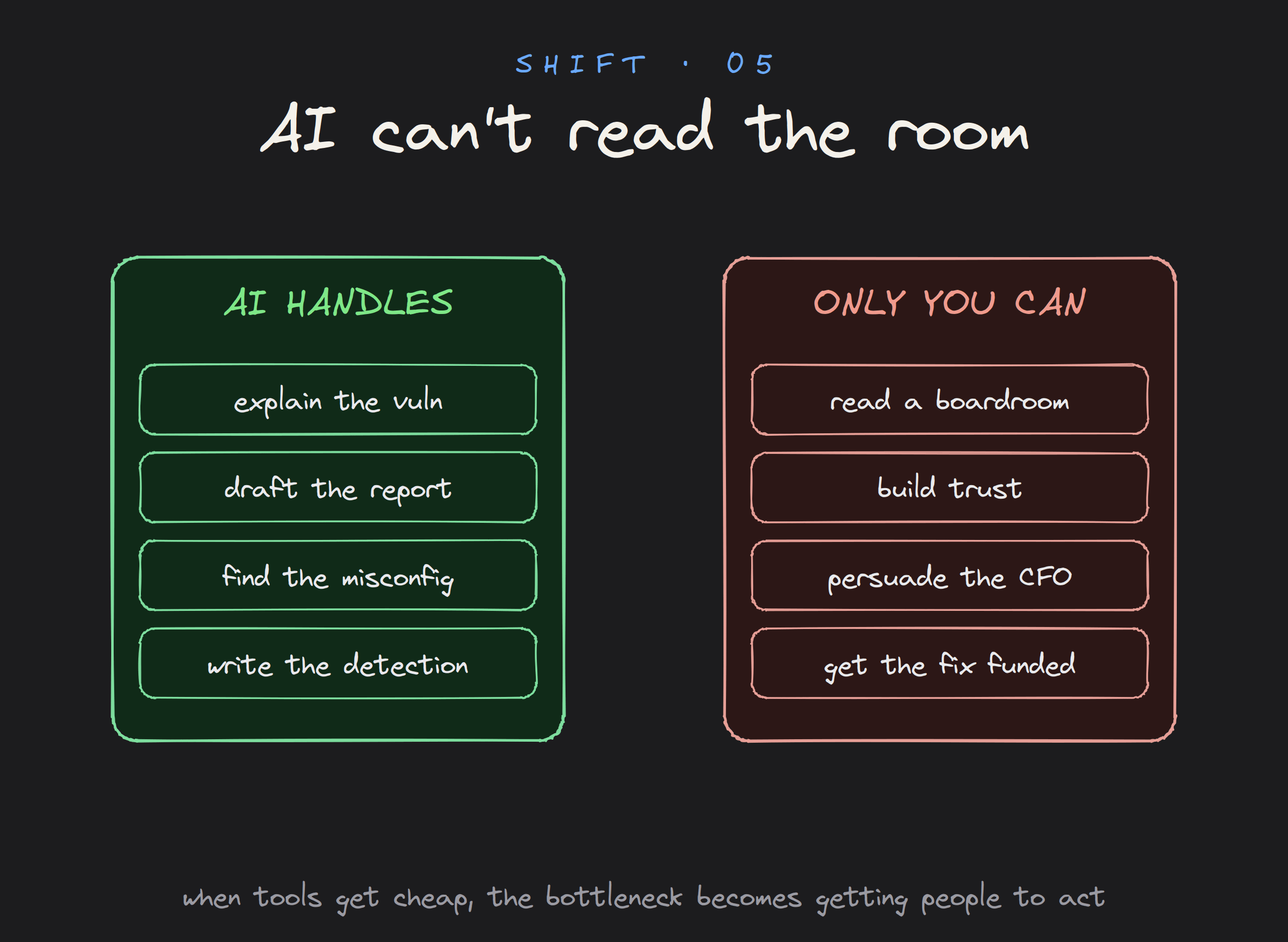
The people who come out ahead this decade won’t necessarily be the most technical. They’ll be the most adaptable .. the ones who can combine security depth with cloud fluency, real AI literacy, threat-modeling instinct, business sense, and the ability to communicate all of it. The people most exposed are the ones whose value is concentrated in exactly the operational tasks the platforms are now automating. Not because they’re bad at their jobs, but because the market has stopped paying a premium for work a system can now do on its own.
What I’d learn if I were starting over
Preparing for this, I’d put my energy into five things: cloud and AI-agent architecture; threat modeling; AI systems and how to govern and supervise them; communication and business judgment; and genuine fluency in using AI as a force multiplier rather than a novelty.
Notice what’s not on that list. No specific product. No particular vendor. No certification. That’s deliberate. Tools change, platforms change, whole categories of the industry change. What survives every one of those shifts is the ability to understand a system, weigh its risks, and make a good decision under uncertainty.
The real question
People keep asking whether AI will replace the security engineer. It’s the wrong question, and the last few months have answered the right one for us. The better question is: what happens when every security engineer has a fleet of capable agents at their back .. and so does every attacker?
The answer isn’t a quieter world with fewer security problems. It’s faster systems, larger environments, more tangled architectures, a sprawl of semi-autonomous agents that all need governing, and higher expectations of whoever is supervising the whole thing. The security engineer doesn’t disappear in that world. The center of gravity just moves .. away from the operator, the ticket-processor, the human API, and toward the strategist, the architect, the orchestrator, the risk advisor, the person responsible for a set of autonomous systems doing the work that used to fill their day.
The ones who see that coming, and start becoming that person now, will have an enormous head start on everyone still training hard for a job that’s quietly ceasing to exist.