
The 5 Skills Every Cybersecurity Engineer Needs in 2026 (That Universities Still Aren’t Teaching)
Are you prepping for a cybersecurity market that does not exist ?

A friend of mine runs security hiring at a mid-sized fintech. Last year he told me about two finalists for the same role.
The first had the résumé you’d design in a lab: a master’s in cybersecurity, a stack of certifications, top marks in every course. The second had a community-college diploma, no master’s, and a GitHub profile .. a scrappy collection of scripts that pulled alerts from an API, auto-triaged them, and posted a tidy summary to Slack every morning. Nothing fancy. Just things that worked.
They hired the second candidate.
When I asked why, my friend shrugged. “The first one could describe security. The second one had already done it. I could picture him solving a real problem on day one. I couldn’t picture the other one doing anything I hadn’t assigned.”
That conversation has stuck with me, because it captures exactly how cybersecurity hiring has changed .. and why so much of the conventional advice is now quietly out of date.
For a long time, the path looked simple: Get a degree. Learn the theory. Earn a certification. Apply for a job.
That advice was never wrong. It’s just no longer enough.
Cybersecurity is going through one of the biggest shifts in its history, and it’s happening faster than the curriculum can keep up. AI agents now triage alerts, enrich investigations, write detection rules, and even find vulnerabilities.. Google DeepMind’s CodeMender has already found novel vulnerabilities in well-tested software. Security teams are being asked to operate at machine speed. By early 2026, roughly three out of four security organizations reported they were already using or building agentic AI inside their operations
At the same time, hiring has moved toward skills over credentials with major firms dropping degee requirements for many technical roles.
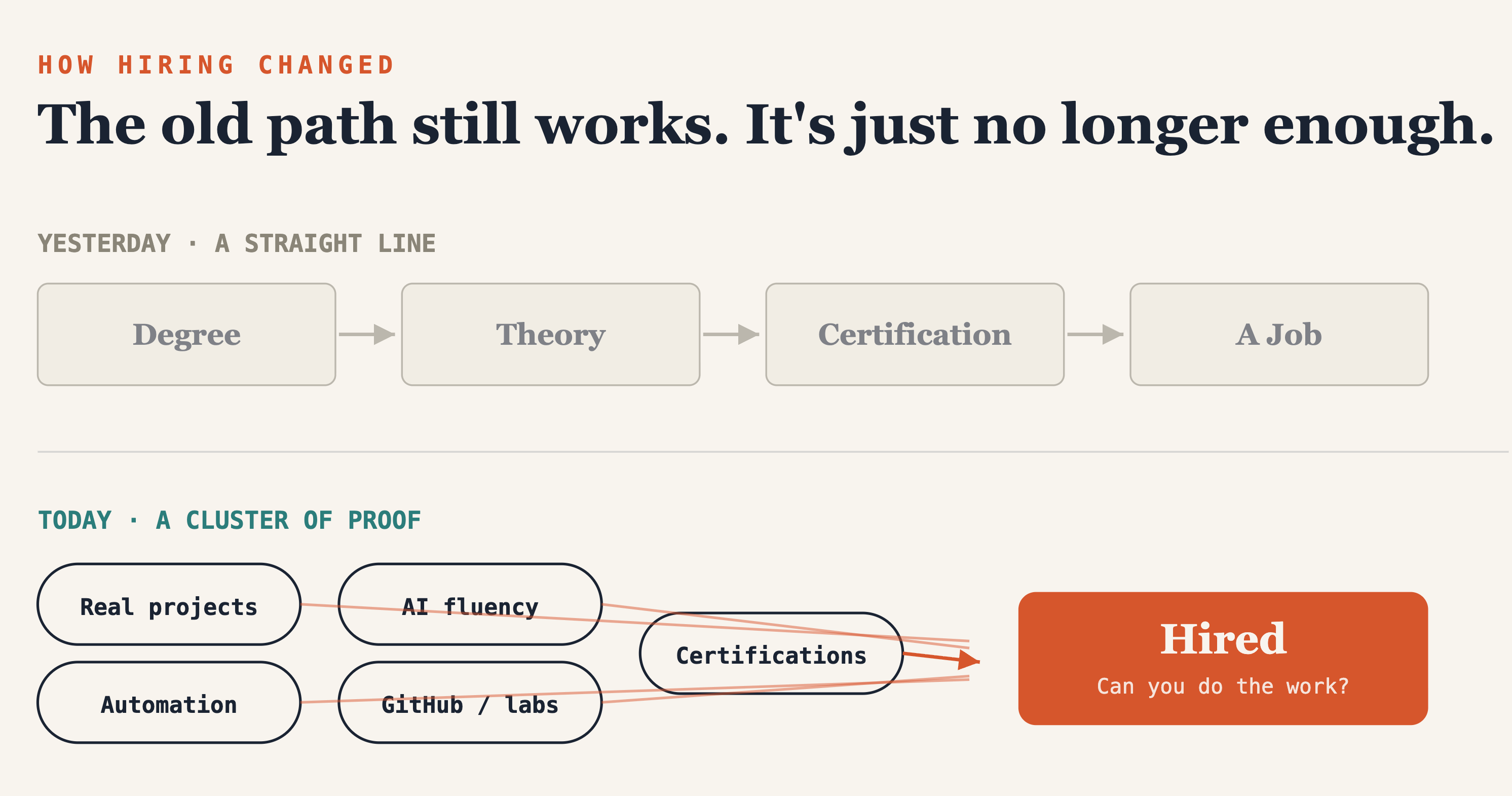
The uncomfortable truth is that many universities are still teaching cybersecurity for a world that no longer exists. Concepts, frameworks, and theory still matter .. but the skills that create outsized career opportunities in 2026 are mostly learned outside the classroom.
The demand is real, and so is the gap with World Economic Forum now ranking cybersecurity skills second only to AI and big data for projected growth across every skill category worldwide.
So the opportunity is enormous.. but it goes to people who can do specific things. Here are the five that separate modern cybersecurity engineers from everyone else.
1. Security Automation
Ten years ago you could survive in security by doing everything by hand. Not anymore.
A modern environment generates millions of events a day. No human reviews every log line or chases every alert .. and the alert volume itself has become a safety problem. In Google Cloud’s 2026 survey of enterprise decision-makers, 82% of analysts said they were worried about missing a real threat simply because of how much data and how many alerts they face.
The engineers creating the most value are the ones who automate the repetitive work. That doesn’t mean becoming a software engineer. It means learning enough Python, PowerShell, Bash, APIs, and workflow tooling (Agentic and the like) to eliminate manual effort wherever it shows up.
A university might teach cryptography, security models, and network protocols. All useful. But employers increasingly care whether you can:
Pull and correlate data from an API
Script an alert investigation end to end
Automate cloud security and compliance checks
Build a workflow that saves analysts hours every week
The engineer who automates almost always outperforms the engineer who memorizes .. and that gap is widening as the cost of manual toil rises.
2. Working Alongside AI Agents
A lot of professionals are still arguing about whether AI will replace cybersecurity jobs. That’s the wrong question. The better one is: can you work effectively alongside it?
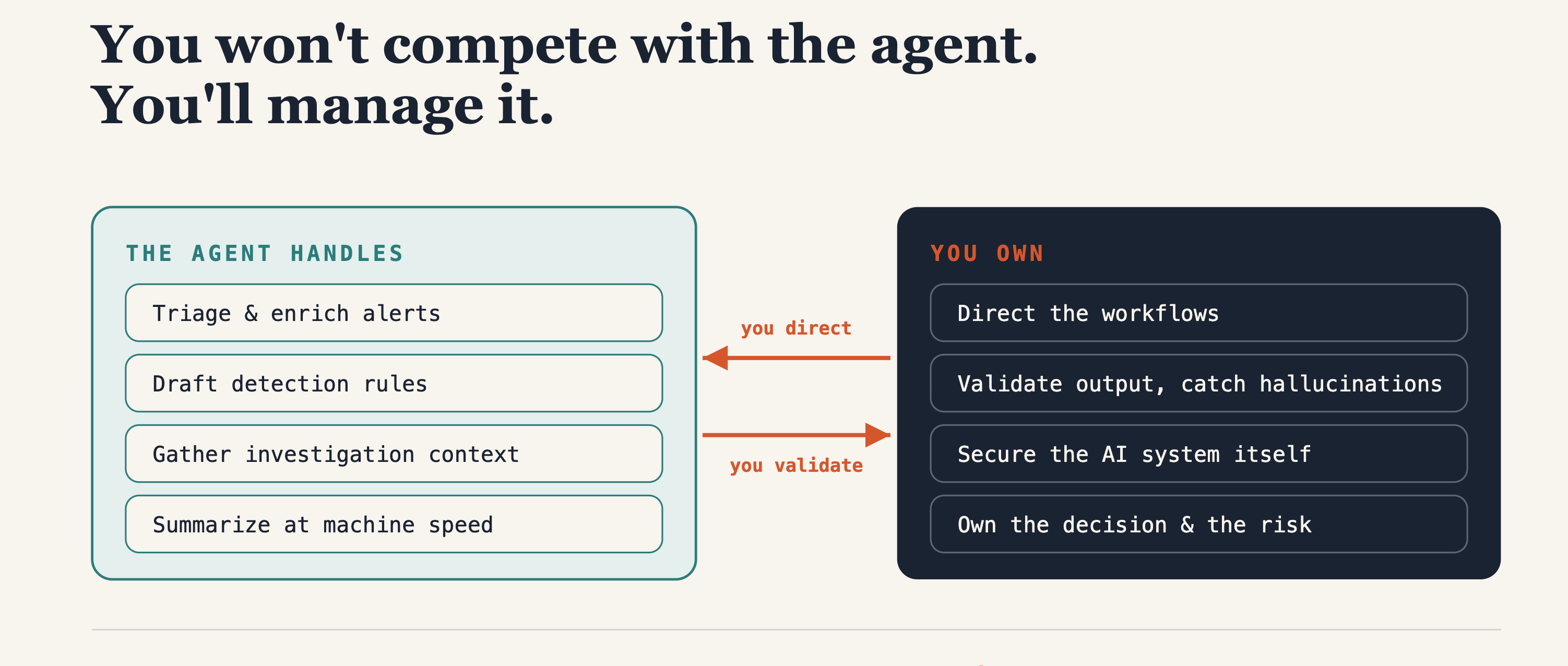
Here’s the nuance most career advice misses: adoption is racing ahead of trust. Only about 14% of security teams currently let AI take independent remediation actions in the SOC. The rest keep a human firmly in the loop. That’s exactly where the jobs are .. not in competing with AI, but in directing it, checking it, and owning the decisions it informs.
The future cybersecurity engineer won’t fight AI. They’ll manage it. Practically, that means learning how to:
Use AI coding and investigation assistants well
Build and tune AI-powered detection and response workflows
Validate AI-generated output and catch hallucinations
Secure AI systems themselves (more on that below)
Apply AI to threat hunting and detection engineering
Most university programs barely touch any of this. Meanwhile, AI skills have become a measurable hiring advantage. Microsoft and LinkedIn’s Work Trend Index has separately reported that around two-thirds of leaders would not hire someone lacking AI skills.
The engineers who get fluent now are the senior engineers of the next few years.
3. Threat Modeling & Architecture Knowledge
This might be the most underrated skill on the list.
Most people learn security controls. Far fewer learn to think like an attacker. Threat modeling is the discipline of systematically asking: what could go wrong, how would an adversary exploit this system, which defenses actually matter, and where should limited resources go first.
It only gets more important as organizations bolt AI agents, APIs, and cloud-native services onto everything. Cisco’s State of AI Security 2026 described organizations handing agentic systems real authority .. to query databases, modify code, trigger workflows .. while only a minority felt prepared to secure those deployments. That is a threat-modeling problem before it’s anything else.
And here’s the encouraging part for anyone worried about chasing every new buzzword: practitioners in the AI security community keep pointing out that the most valuable “AI security” skills are mostly traditional application-security and threat-modeling principles applied to new technology. Frameworks like STRIDE are being adapted to AI systems; new architectures like Retrieval-Augmented Generation create fresh attack surfaces, but the way you reason about them is the same disciplined thinking you’d apply anywhere.
A course can explain a framework. Threat modeling teaches you how to think — and thinking is much harder to automate than running a scan.
4. Cloud (and AI) Architecture
Many cybersecurity graduates understand attacks. Far fewer understand how modern systems are actually built .. and that’s a problem, because security decisions are now architectural decisions.
Today’s security engineers are expected to understand cloud networking, identity and access management, containers and Kubernetes, serverless, infrastructure as code, and multi-cloud environments. Increasingly they’re also expected to understand the AI layer sitting on top of all of it — model interfaces, tool integrations, and the supply chain feeding them.
This is consistently one of the hardest skill sets to hire for. Industry outlooks for 2026 repeatedly flag cloud and identity security roles as among the most difficult positions to fill, and the market pays accordingly.
When a company migrates thousands of workloads to the cloud, they don’t need someone who can explain what a firewall does. They need someone who can design a secure system. That’s a different skill entirely — and it’s where identity, not the network perimeter, has quietly become the real control point.
5. Communication and Business Context
This is the skill almost nobody expects to matter. It may be the most important one on the list.
Cybersecurity has become a business discipline, not just a technical one. A growing share of security vacancies now ask for a blend of technical depth and business understanding rather than pure technical capability.
Here’s why, in two sentences. Engineer A says: “This server is vulnerable to privilege escalation.” Engineer B says: “This vulnerability could let an attacker reach customer records, which creates a regulatory exposure that could affect revenue.”
Engineer B gets promoted.
The interesting thing is that this skill is becoming more valuable precisely because AI is getting good at the technical layer. As agents take over context-gathering and first-pass analysis, the differentiating human work moves up the stack.. toward judgment, prioritization, and persuasion. The best engineers can:
Explain risk to executives in their language
Justify security investment in terms of business impact
Translate technical findings into consequences leaders care about
Influence decisions without holding formal authority
Universities teach technology. They rarely teach influence. Yet influence is what gets security initiatives funded and shipped.
The Real Career Advantage in 2026
The biggest misconception in cybersecurity is that employers are hunting for the people who know the most. Increasingly, they’re hunting for the people who can do the most.
That’s why portfolios matter. That’s why hands-on projects matter. That’s why a GitHub repo full of working automation, a documented home lab, or a cloud sandbox you broke and rebuilt can outweigh a transcript. Nearly two-thirds of employers now use some form of skills-based evaluation for entry-level hires, and a Security+ certification plus a portfolio of real projects routinely beats a degree alone in early-career interviews.
The engineers who thrive over the next decade won’t necessarily have the most impressive academic credentials. They’ll be the people who can automate workflows, direct AI rather than fear it, threat-model complex systems, design secure cloud and AI architectures, and communicate risk in the language of the business.
Universities still provide a valuable foundation. But a foundation is only the beginning.
The people building the biggest opportunities for themselves right now are doing it on nights and weekends .. in home labs, GitHub projects, cloud sandboxes, and real experiments. And that’s exactly why self-directed learners have never had a bigger advantage than they do in 2026.