
Most Cybersecurity Professionals Are Using Claude Code Wrong (And Don’t Realize It)
Stop Prompting Claude. Start Building Security Systems Instead

In case you’ve been living under a rock, Claude Code is everywhere right now.
Cybersecurity professionals are experimenting with it, developers are using it daily, and teams are starting to bring it into their workflows.
But here’s the problem. Most people are barely scratching the surface.
They’re using it to ask questions, review snippets of code, maybe get a quick security check. And while that feels useful, it hasn’t actually changed how they do security.
It’s still reactive. Still manual. Still dependent on someone remembering to use it.
What most people haven’t realised yet is that Claude Code isn’t just a tool you open when you need help.
It’s something you can design into your environment. And when you do that, it stops being something you ask… and starts becoming something that actively works as part of your cybersecurity team
What needs to change is not just how we use Claude Code .. but how we think about security itself.
Using Claude Code has levels and right now, most cyber professionals are operating at Level 1 : AI Chatbot.
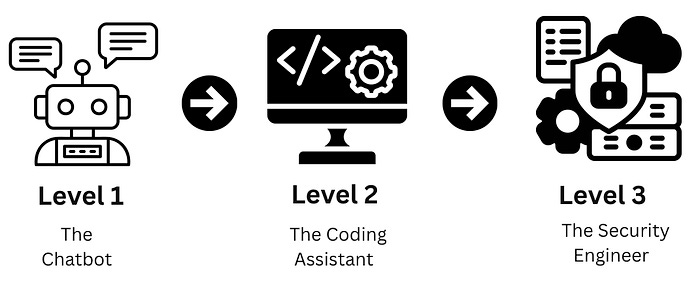
They interact with Claude in a conversational way .. asking questions about vulnerabilities, requesting fixes, or pasting snippets of code for review. The responses are often useful and sometimes surprisingly detailed, which creates the feeling that real progress is being made.
But this is still a very shallow level of adoption.
Every interaction starts from scratch. There is no memory of previous work, no consistent structure, and no connection to real systems. The quality of the output depends entirely on how the question is asked in that moment. If the prompt is weak, the outcome is weak. If the prompt is strong, the result improves .. but only temporarily.
This creates an illusion of capability. It feels like you are doing AI-powered security, but in reality, you are just having better conversations.
The core issue here is subtle but important: Claude is being treated like an advanced search engine, not as part of a security system.
And that limits everything that follows.
Level 2 - Where Most People Plateau
Some professionals move beyond simple chat interactions and begin using Claude Code more actively inside their development workflows. This is Level 2 - AI Developer, and it represents a meaningful step forward.
At this stage, Claude is used to generate scripts, assist with building internal tools, and review application code within repositories. Security engineers start to rely on it for faster analysis and quicker iterations. They feel more productive, and in many ways, they are.
But even here, there is a ceiling.
The work is still largely manual. Each task has to be initiated by a human. The quality of the output still varies depending on how the problem is framed. There is no consistent enforcement of security standards across projects. One day, a thorough review happens. The next day, something is missed .. not because the tool failed, but because the process was not designed to guarantee consistency
This is where most people stop. It feels advanced enough. It feels efficient. But it is not transformational.
The Core Problem: Human-Centric Security
To understand why Levels 1 and 2 fall short, you have to look at how cybersecurity has traditionally been structured.
Security has always depended heavily on human effort. Analysts investigate alerts, engineers review code, architects design controls, and auditors validate compliance. Even with automation, the system is still designed around people making decisions at every step.
When Claude is introduced without changing this model, it simply accelerates individual tasks. Reviews happen faster. Scripts are written quicker. Answers are easier to find.
But the structure itself does not change.
This is why many AI initiatives feel underwhelming. They improve speed, but not outcomes. They reduce effort, but not risk.
The real opportunity is not to make humans more efficient. It is to reduce how much security depends on humans in the first place.
Level 3 : The Shift to AI Security Engineering
This is where Level 3 - AI Security Engineer becomes important.
At this level, Claude is no longer something you interact with occasionally. It becomes embedded into the way your systems operate. Instead of asking Claude what to do, you design environments where Claude is already doing it.
The shift is from usage to architecture.
Security is no longer triggered by a person remembering to take action. It is built into the workflow itself.
Level 3 is where the real transformation begins.
At this stage, Claude is no longer something you “use” on demand. It becomes part of the underlying system that drives how security is implemented, enforced, and scaled. Instead of relying on humans to initiate reviews, remember checks, or ask the right questions, you design an environment where those things happen automatically.
This is the shift from interaction to architecture.
Security is no longer dependent on individual effort. It is embedded into the workflow itself .. consistent, repeatable, and always active.
At a high level, Level 3 is built on a few key layers:
Persistent Context (CLAUDE.md): Security policies, coding standards, and expectations are defined once and automatically applied across every session
Repeatable Workflows (Skills): Structured security tasks such as threat modeling and code reviews are standardized and reusable
Real-World Integration (MCP): Claude connects to actual security tools, data sources, and environments instead of working in isolation
Parallel Analysis (Sub-Agents): Multiple specialized agents run assessments simultaneously, improving depth and speed
Automated Enforcement (Hooks): Security checks are embedded into pipelines and workflows, ensuring they cannot be skipped
Together, these layers turn Claude from a helpful assistant into a core part of your security architecture.
What follows is not just better productivity .. it is a fundamentally different way of doing security.
The Mindset Shift
Reaching Level 3 is not about learning more prompts or mastering a new tool. It requires a fundamental shift in thinking.
Instead of focusing on how to use Claude more effectively, the focus moves to how to design systems that make security automatic. You stop thinking in terms of individual tasks and start thinking in terms of workflows and architecture.
You begin to ask different questions. Not “How do I review this code?” but “How do I ensure all code is always reviewed to the same standard?” Not “How do I remember to check for vulnerabilities?” but “How do I make it impossible to skip that check?”
This is the difference between using AI and building with AI.
Why This Matters Now
The pace of software development is changing rapidly. With AI-assisted coding and agentic systems, code is being generated and deployed faster than ever before. The traditional model ..where humans review and validate each step .. cannot keep up with this speed.
If security continues to rely on manual effort, it will become the bottleneck.
And when organizations face that bottleneck, they will make a choice: slow down innovation, or bypass security.
Neither outcome is acceptable.
Level 3 offers a different path. It allows security to scale alongside development, not lag behind it. It ensures that validation happens continuously and automatically, without requiring constant human intervention.
The ultimate goal is not to become better at using Claude Code. It is to create an environment where security is built into everything by default.
In such an environment, every repository carries its own security context. Every change is evaluated automatically. Risks are identified with real-world context, and workflows are consistent across teams.
Security stops being something you remember to do.
It becomes something the system does for you.
Final Thought
Most professionals today are still operating at Levels 1 and 2. They are faster and more efficient, but they are still constrained by the same underlying model.
The real transformation happens at Level 3.
Not when you get better at prompting.
But when you stop relying on prompts altogether — and start designing systems where security is always on, always consistent, and always enforced.
Because in the age of AI, the real advantage is not finding vulnerabilities faster. It is building systems where they are far less likely to exist in the first place.
Want to Learn How to Do This in Practice?
If you want to learn how to apply this in practice then , I’ve created a practical course designed specifically for cybersecurity professionals and software engineers
The course walks through how to rethink the mental model for Claude code and turn into a living member of your cybersecurity team
You can it for a special discount below. Paid subscribers get it for free . Thanks for supporting this newsletter !
👉 Mastering Claude Code For Cybersecurity Professionals
Link for Paid Subscribers below:
