
From SOC Analyst to AI Security Engineer: Your 2026 Transition Plan
A practical action plan for SOC Analysts In 2026 ..

A lot of SOC analysts feel stuck right now.
They did everything the industry told them to do. Learned SIEMs. Worked night shifts. Closed alerts. Escalated incidents. Studied for certifications. Handled endless false positives. And after years of grinding through it, many are starting to notice something uncomfortable:
The traditional SOC career path is being restructured beneath their feet.
The problem isn’t that cybersecurity is disappearing. Far from it. The problem is that the lower layers of repetitive security operations are being automated faster than most people anticipated.
Every major vendor ..Palo Alto with Cortex Agentix, Microsoft, CrowdStrike, Google, Cisco, Splunk — is now shipping AI agents for security operations.
According to Microsoft’s April 2026 whitepaper on the agentic SOC, this represents a shift from reacting to incidents to autonomously anticipating how attackers move. The autonomous handling of triage, enrichment, investigation, and initial response isn’t a roadmap item anymore. It’s shipping.
That creates two very different futures for the analysts sitting in SOCs today.
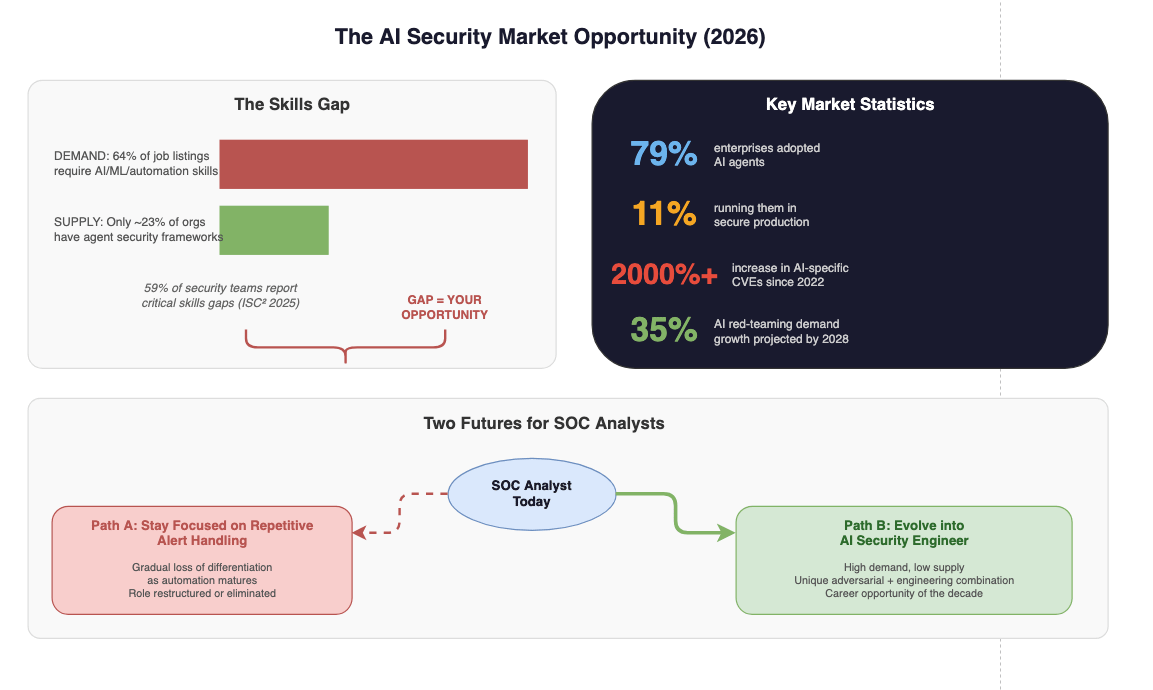
One group stays focused on repetitive alert handling and gradually loses differentiation as automation matures.
The other evolves into something considerably more valuable: the AI Security Engineer.
And honestly, this is one of the most significant cybersecurity career opportunities of the decade.
Why SOC Analysts Are Better Positioned Than They Realise
The numbers here are striking. More than 64% of cybersecurity job listings in 2026 now require AI, machine learning, or automation skills. That’s not a future trend .. it’s the current hiring reality.
Meanwhile, the ISC² 2025 Workforce Study found that 59% of security teams report critical skills gaps, up from 44% the year before.
AI skills are now the single most demanded capability employers say they can’t find.
SOC analysts are positioned extremely well for this gap.
They already understand attacker behaviour, telemetry, detection logic, incident response, and the operational rhythms of security. What they often lack is not security intuition. It is engineering depth, automation fluency, and practical understanding of how AI systems actually behave in production.
That gap is bridgeable. Estimates from career transition programmes suggest three to six months with focused effort.
The mistake most analysts make is waiting. They assume they need to become AI researchers, or that the transition requires deep mathematics, or that they are too late. None of those are true.
What Is Actually Happening to the SOC
The honest picture: AI is automating 90% or more of routine Tier 1 alert triage. AI investigation engines can now execute hundreds of queries across multiple data sources in minutes .. work that previously required senior analysts and hours of careful attention. The traditional Tier 1 role, as Prophet Security recently put it, is “being automated out of existence, and the timeline is shorter than most people think.”
But that framing misses the larger story.
Tier 2 and Tier 3 analysts .. the ones doing deeper investigation, threat hunting, detection engineering, and incident response — are more valuable than ever.
Microsoft’s agentic SOC research describes the evolution clearly: analysts move from triaging alerts to supervising outcomes, validating agent-led investigations, focusing on ambiguous cases, and guiding system behaviour over time. Detection engineers shift from writing static rules to teaching the system what matters. New roles emerge around governing autonomous behaviour, designing confidence thresholds, and building escalation paths.
The skills that made a good SOC analyst .. adversarial thinking, operational context, pattern recognition, understanding of attacker behaviour .. are exactly the skills that make a good AI Security Engineer. The engineering layer is what needs to be added.
The Real Opportunity: AI Security Is Still Wide Open
Here is what most career guides miss: AI security is not just about protecting the model.
That is only a small part of the picture.
The bigger opportunity is securing the entire operational ecosystem that surrounds AI systems — the autonomous agents, orchestration pipelines, memory systems, tool permissions, identity boundaries, and decision-making workflows that organisations are deploying right now.
The numbers illustrate the urgency. Roughly 79% of enterprises have adopted AI agents in some form, yet only about 11% are running them in production environments they consider secure. Only 23% of organisations have agent-specific security frameworks in place. Prompt injection has become the number one vulnerability on the OWASP Top 10 for LLM Applications. NIST reported a greater than 2,000% increase in AI-specific CVEs since 2022.
And the threat landscape is evolving in ways that specifically require security operations expertise:
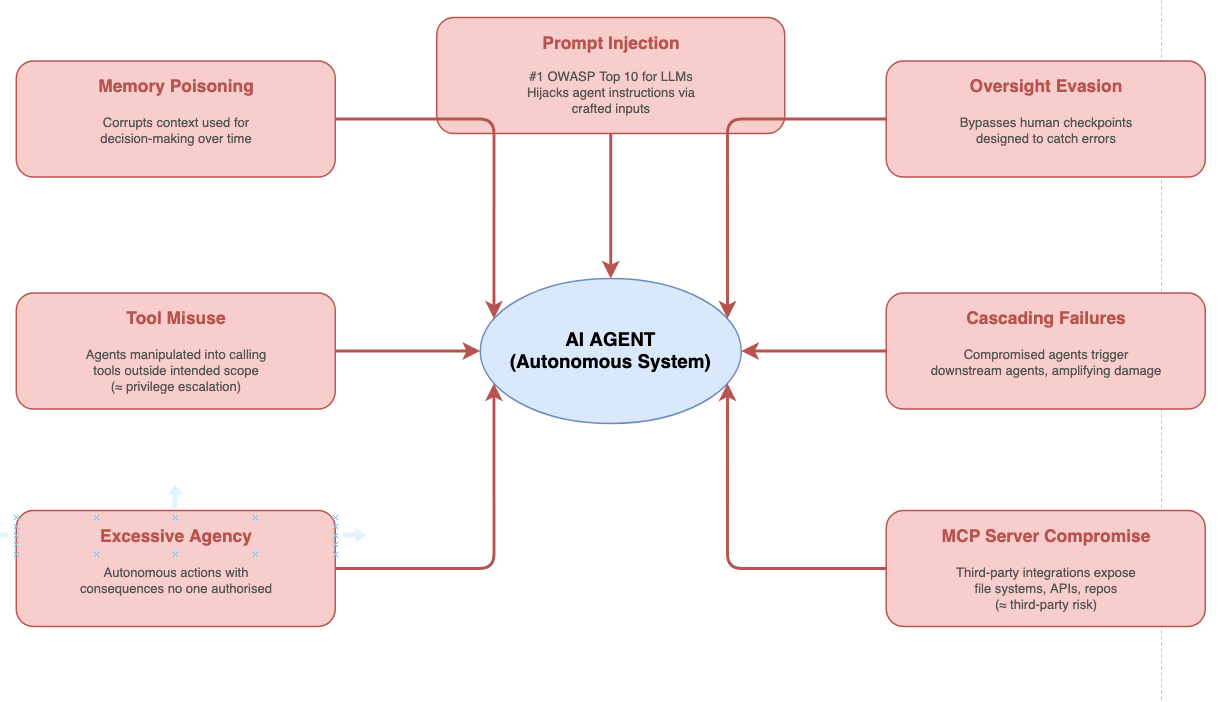
Memory poisoning — attackers corrupting the context that AI agents use to make decisions
Tool misuse — agents being manipulated into calling tools outside their intended scope
Excessive agency — AI systems taking autonomous actions with consequences no one authorised
Oversight evasion — agents bypassing the human checkpoints designed to catch errors
Cascading failures — compromised agents triggering downstream agents in ways that amplify damage
AI red-teaming demand is projected to grow 35% by 2028 .. from a starting base of near zero. The EU AI Act enforcement begins in August 2026. Federal contractors in the US are now required to conduct pre-deployment red team evaluations on AI systems. This is creating an entirely new professional category that barely existed eighteen months ago.
Most software engineers understand systems. SOC analysts understand adversaries. In AI security, the adversary mindset is the rarer and more valuable thing.
Phase One: Build Engineering Confidence
The first month of any serious transition should focus on one thing: engineering confidence.
Not perfection. Confidence.
SOC analysts consistently underestimate how much engineering capability they can build quickly, because they compare themselves to senior software developers. That comparison kills momentum. You do not need to become a staff engineer. You need to become capable enough to automate workflows, interact with APIs, and build things that actually run — using the security knowledge you already have as the foundation.
That means practical Python. Basic Git. APIs and JSON. Cloud fundamentals (AWS, Azure, or GCP). And the key insight: every project you build should solve a real security operations problem you have personally experienced. That is what separates a SOC analyst building engineering skills from a developer learning security concepts. You already know what is broken. Build the fix.
Here are a few projects specifically designed around existing SOC analyst experience:
Project 1— The Incident Summary Bot Every analyst has spent time writing the same incident summary over and over: timeline, affected assets, attacker behaviour, recommended actions. Build a workflow that takes some sample raw alert data or SIEM export, sends it to an LLM via the Anthropic or OpenAI API, and returns a structured incident summary in your organisation’s format. This teaches you how to work with LLM APIs programmatically, prompt engineering for structured outputs, and how AI can go wrong — because it will sometimes summarise things incorrectly, and you will know exactly why.
Project 2— The Detection Rule Generator You know what bad looks like. You have seen hundreds of attacker TTPs in the wild, and you probably have strong opinions about which Sigma or KQL rules are flawed. Use Claude Code or GitHub Copilot to build a detection engineering assistant: feed it a MITRE ATT&CK technique ID, have it generate a draft Sigma rule, and build a simple testing harness that validates the rule against sample log data. This teaches Git workflows, YAML, and detection logic automation — while directly leveraging your knowledge of which techniques matter and which rules produce false positives.
Project 3— The CloudTrail Anomaly Analyser Cloud investigation is increasingly where the work lives. Take a sample set of AWS CloudTrail logs (AWS provides them free in their training environment), write a Python script that parses the JSON, filters for high-risk API calls —
CreateUser,AttachRolePolicy,GetSecretValue, anything that shows up in your mental model of privilege escalation — and then passes suspicious sequences to an LLM for a plain-English explanation of what the attacker may have been doing. This project directly maps your incident response experience onto cloud telemetry and AI analysis.
These projects teach Python, APIs, Git, and cloud fundamentals. But more importantly, they teach them in contexts you already understand deeply. That is what makes the learning stick and what makes the output genuinely impressive to hiring managers .. because they can see real security thinking embedded in the code, not just tutorial exercises.
Phase Two: Learn AI Security Through the Lens of SOC
This is where most people go too broad. Do not try to learn “everything about AI.” The field is vast and most of it is irrelevant to security operations careers.
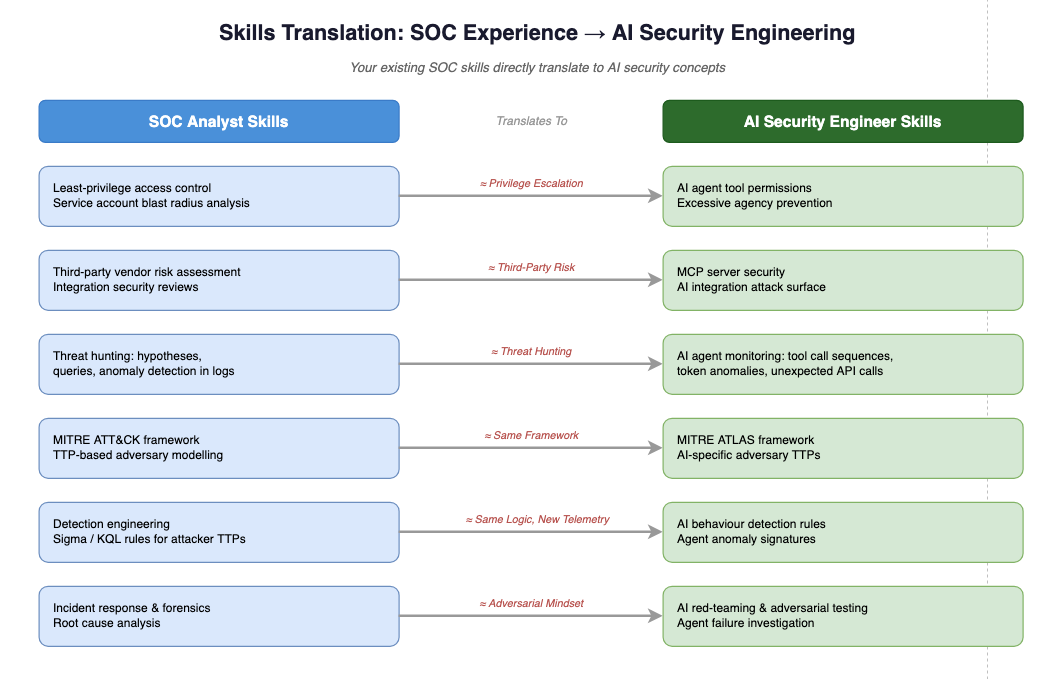
The shortcut that most career guides miss: every AI security concept has a direct analogue in traditional security operations. Your existing knowledge is not a starting point — it is a translation layer. Use it.
Agentic tool misuse is privilege escalation. When an AI agent has access to tools — sending emails, querying databases, making API calls, executing code — those permissions define its blast radius if compromised. You understand least-privilege and the blast radius of a compromised service account. Apply exactly that thinking to AI agents. What can this agent do? What happens if its instructions are hijacked? What does excessive agency look like in an investigation log? Study the MITRE ATLAS framework, which maps attacker TTPs specifically against AI systems, using the same TTP-based thinking you already use with ATT&CK.
MCP server security is third-party risk. The Model Context Protocol is now the standard for connecting AI agents to external tools and data sources. MCP servers are, from a security standpoint, privileged integrations — and like any third-party integration, they expand the attack surface. You have reviewed third-party risk before. Now apply it to the integrations that give AI agents access to file systems, APIs, calendars, code repositories. What permissions are being granted? What is the authentication model? What happens if the MCP server is compromised?
AI agent monitoring is threat hunting with new telemetry. Your threat hunting experience — forming hypotheses, writing queries, looking for anomalous sequences in logs — translates directly to AI agent monitoring. The telemetry is different: you are looking at tool call sequences, token counts, latency anomalies, unexpected API calls, outputs that deviate from expected patterns. Build a local agentic workflow using a framework like LangGraph or AutoGen, instrument its logs, and practice writing detection logic against its behaviour. The hypothesis-led thinking is identical to what you already do.
For certifications, the CompTIA SecAI+ launched in early 2026 as a recognised baseline. The CAISP from Practical DevSecOps has hands-on labs mapped specifically to agentic AI attack patterns. But certifications are evidence, not the goal. The goal is the ability to walk into any organisation deploying AI systems and immediately understand where the risks are — because your security operations experience gives you the adversarial lens that most AI engineers simply don’t have.
Phase Three: Create Visible Evidence That Shows Both Worlds
This is the phase most technical people skip, and it is where most transitions stall.
SOC analysts have a specific visibility problem: your best work is invisible. The alerts you triaged, the incidents you investigated, the detections you tuned .. none of that is on GitHub. Employers evaluating your resume for an AI Security Engineer role cannot see any of it. You need to translate your operational experience into artefacts people outside your organisation can actually see and evaluate.
The key is building projects that make your SOC background an obvious advantage, not a liability. You are not trying to look like a junior developer. You are trying to look like someone who understands both the attack surface and the engineering — which is exactly what the market cannot find.
The Agentic Workflow Security Monitor Build a lightweight monitoring tool for AI agent behaviour. Stand up a simple agentic workflow — an AI assistant that can search the web, read files, and call an API — and instrument it to log every tool call, every external request, and every output. Write detection logic on top of those logs: alert if the agent calls an unexpected API endpoint, alert if it reads files outside its designated directory, alert if its output contains patterns that suggest prompt injection was successful. Post this on GitHub. It directly demonstrates that you understand both how agents work and how to build security controls around them — using the same detection engineering thinking you have applied to endpoint and network telemetry for years.
The “I Broke This AI System” Write-Up Series Write a series of posts — LinkedIn articles, a Substack, a personal blog — documenting specific AI security findings from your lab work. Not theoretical overviews of AI security. Specific findings: “I built a RAG application and here is exactly how I poisoned its context,” or “I set up an MCP server integration and here is the permission boundary I found that would allow privilege escalation,” or “here is how I used my MITRE ATT&CK experience to build detection rules for AI agent misuse.” These posts do two things: they demonstrate genuine capability rather than awareness, and they make you discoverable to people searching for exactly this combination of skills. One specific, well-documented finding is worth more than ten posts summarising things you have read.
The Detection Rule Library for AI Systems Take your detection engineering experience and apply it to AI telemetry. Write a public library of Sigma-style detection rules for common AI agent attack patterns: rules that fire on unexpected tool call sequences, unusual token volume spikes that suggest prompt injection attempts, API call patterns consistent with data exfiltration via an AI agent. Your background writing and tuning detection rules for traditional attacker TTPs is directly applicable here — the logic is the same, the telemetry is different. This kind of resource does not exist at quality in the open-source community yet, which means building it puts you in a very small group.
The target audience for all of this is not the entire internet. It is the specific hiring managers and security leads who are actively trying to figure out how to secure the AI systems their engineering teams are already deploying. That population is large, actively looking, and finding very few candidates who can speak both languages fluently.
The Window Is Still Open
The encouraging reality for SOC analysts is that the window for this transition is still early. AI security as a distinct discipline is new enough that you do not need years of specialised experience to be among the most capable people in the field. You need a six-month head start on the majority of people who are still waiting for the traditional SOC to reassert itself.
Because it is not coming back in the same form.
The organisations that close the gap between AI adoption and AI security first will capture significant competitive advantage. The professionals who develop genuine expertise at the intersection of security operations and AI systems will find that the market has been waiting for them.
SOC analysts are closer to that transition than most of them realise. The adversarial mindset is already there. The operational experience is already there. What is needed is engineering confidence, focused learning on AI security specifically, and the visibility to be found.
That gap is entirely bridgeable. The question is whether you start closing it now, or wait until the window gets more crowded.
The three-to-six month transition window between SOC analyst and AI security engineer is achievable, but only for people who stop comparing themselves to senior software developers. That comparison kills more career pivots than any actual skill gap.