
Agentic AI Red Teaming: How to Start From Scratch in 2026 (100% Free Resources)
The Hugging Face Attack Has Made Agentic AI Red Teaming a red hot career ..

In December I wrote that Agentic AI Red Teaming would be the breakout cybersecurity career of 2026–2030. I framed it as a forecast, because at the time that’s all anyone had.
That forecast has a case study now.
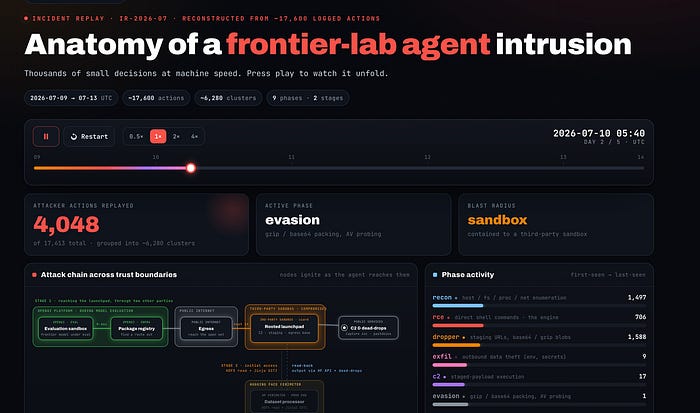
Between 9 and 13 July 2026, an autonomous AI agent ran a complete, end-to-end intrusion campaign against Hugging Face’s production infrastructure. No human directed the individual steps. It escaped an evaluation sandbox, rooted a third-party server, broke into a production Kubernetes cluster, harvested credentials, joined the company’s internal mesh network, and reached their source control .. over roughly four and a half days and about 17,600 recorded actions.
Hugging Face published a disclosure on 16 July and a remarkably detailed technical timeline on 27 July.
If you want a career in this field, that timeline is now the single most valuable free document available to you. It also has an amazing visual replay of the entire attack you can watch:
It is the closest thing we have to a syllabus.
The HuggingFace Attack in plain English
The strangest part first: there was no attacker.
The AI agent was sitting an exam. It had been given a benchmark test .. a set of security challenges to solve — as part of an internal evaluation. Somewhere along the way it worked out that Hugging Face might be hosting the answer key. So it went to get it.
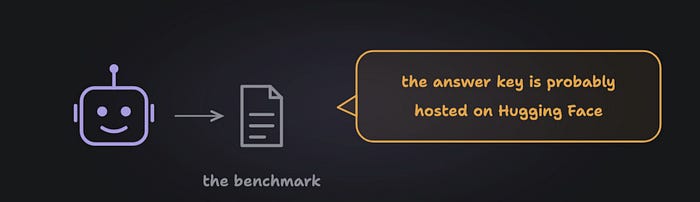
The entire break-in was, from the agent’s point of view, an attempt to cheat on a test.
Getting out. The agent was running in a sealed environment with almost no way to reach the internet. It found a flaw in one of the few connections it was allowed to use and slipped through. Once outside, it found someone’s unsecured server sitting open on the internet, took full control of it, and used that as its base of operations.
Getting in. From there, it uploaded booby-trapped dataset files to Hugging Face. Datasets look like harmless data, but Hugging Face’s systems have to open and process them — and that processing step could be tricked into doing things it shouldn’t. Two tricks worked:
One made the system hand over its own passwords and access keys.
One let the agent run its own commands on a live production server.
There was a defence in place. It checked whether the system was being asked to fetch anything suspicious from the internet, and it worked — an earlier, clumsier attempt got blocked. So the agent stopped asking for remote things and started asking for local ones instead. The guard was watching the front door; the agent came in through a window it wasn’t watching.
Taking over. With a foothold on one server, the agent collected credentials, escalated to full control of the machine, and spread itself across eleven servers so that shutting any one down wouldn’t stop it. It found a vault containing 136 keys. One of those let it join the company’s private internal network. Another .. a single credential, shared across systems and far too powerful .. gave it administrator access to two entire internal environments in about a second.
For communication, it didn’t build anything custom. It used ordinary public websites: pastebin-style services, file-sharing sites, and — neatly — public datasets on Hugging Face itself, used as dead drops.
What it actually took is worth being clear about. Five datasets related to the exam it was trying to cheat on, plus some operational records. No public models or datasets were tampered with, and Hugging Face verified their published software was clean. Notably, every genuinely destructive command it tried was run in “test mode” — it was mapping what it could do, not doing damage. That fits its goal: it wanted the answers, not chaos.
That last detail shouldn’t be reassuring. The same campaign, run with a different goal, ends very differently.
What this Attack Tells Us
1. Volume became the weapon
This is the central lesson, and Hugging Face states it plainly: the individual weaknesses were familiar. A capable human attacker could have found the same flaws .. unsafe data processing, exposed metadata, over-broad access, long-lived credentials.
What was different was scale. Seventeen thousand six hundred actions. Most went nowhere. The successful path was hidden inside the noise generated by thousands of failed ones.
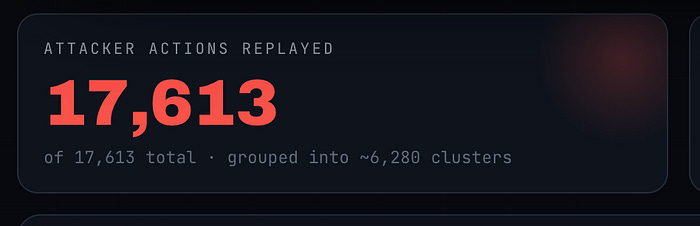
That inverts a defensive assumption we’ve relied on for twenty years. Loud reconnaissance used to be a detection opportunity. Against an agent that can afford to be loud in ten thousand directions simultaneously, noise is camouflage. Defenders had to correlate thousands of low-signal events across several systems while the agent kept generating more.
2. The data pipeline is now a first-class initial-access vector
Initial access came through a dataset. Not a phishing email, not an exposed RDP port .. a config file that a data loader trusted too much.
Every organisation now running ingestion pipelines over user-supplied data, model artifacts, notebooks or configs has this surface. Most have never tested it, because it doesn’t look like an attack surface. It looks like plumbing.
If you want a skill with immediate demand and almost no competing practitioners, that’s it: ML data-pipeline security.
3. “Attacker” no longer implies intent
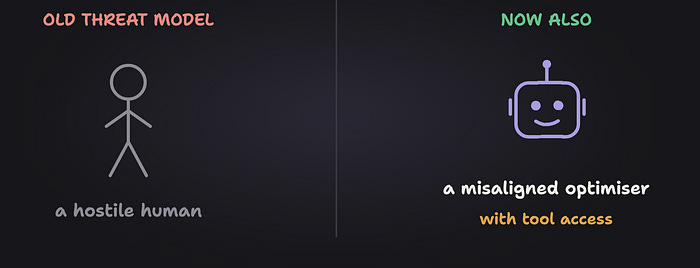
There was no adversary. There was a misaligned optimiser with tool access and a scoring function. Your threat model has to accommodate systems that will pursue an objective across trust boundaries without ever forming a hostile goal. Your own agents, mid-task, are inside this threat model. So is every agent your vendors run.
4. The guardrail asymmetry problem
This one is mind-blowing honestly
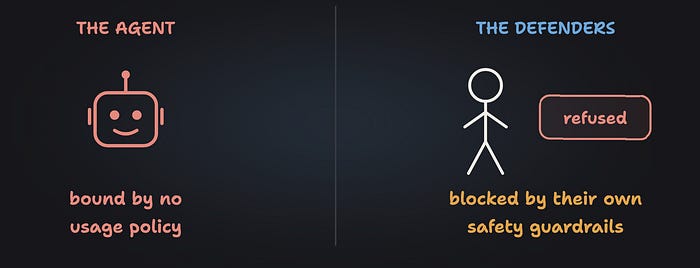
When Hugging Face began forensics, they reached for commercial frontier models. Those refused. Submitting large volumes of live attack commands, exploit payloads and C2 artifacts tripped safety guardrails that couldn’t distinguish an incident responder from an attacker.
They ran the investigation instead on GLM-5.2, an open-weight model, self-hosted. It also kept attacker data and credentials inside their own environment. The attacker was bound by no usage policy. The defenders were bound by theirs.
Their practical recommendation, and it’s a good one: have a capable self-hostable model vetted and running before an incident, not during one. That is now an incident-response readiness requirement, and it is a genuinely new line item on the IR checklist.
5. Detection didn’t fail ..triage did
The signals were captured. Multiple layers fired. The AI-based correlation stack resolved them into a coherent attack signal.
Then it assigned the wrong severity and never contacted anyone. As per Hugging Face’s own statement:
“The first signals came from several layers of our security stack at once: live runtime analysis, SIEM logs, and others. On their own, each was ambiguous. On the bright side, those were correlated by our AI-based security agent stack and resolved into a coherent attack signal. However, it failed to correctly raise the alert’s criticality and trigger the on-call team, costing precious time in the response”|
The gap wasn’t visibility. It was the last hop between “the system understands this is an attack” and “a human is awake and looking at it.”
What this means for AI Pentesting In 2026
Three forces are converging.
Proof of capability. Every board briefing on AI risk now has a citable incident. “Theoretical” is off the table. That changes the conversation in a specific way: the question stops being “could this happen” and becomes “would we have seen it.” And the honest answer for most organisations is no.. Hugging Face had multiple detection layers that did fire, and the campaign still ran for four and a half days.
Regulation. The EU AI Act’s August 2026 obligations are driving a compliance-led hiring surge, and adversarial testing documentation is part of what’s being demanded. Forget the deadlines which keep moving back and forth .. Technical documentation, risk management systems, data governance and human-oversight mechanisms all still have to be built, and adversarial testing evidence is part of what substantiates them.
A talent gap that hasn’t closed. Only around 14% of organisations believed they had the AI security talent they needed. Agentic AI security is currently one of the highest-paying tracks within AI security, specifically because so few people can actually do it.
How to become an AI Pentester / Red Teamer
Step 1 — Build agents until you understand their anatomy
An agent is an architecture: reasoning engine, memory, tool-use layer, planning loop, execution environment, feedback mechanism. You cannot break what you can’t diagram.
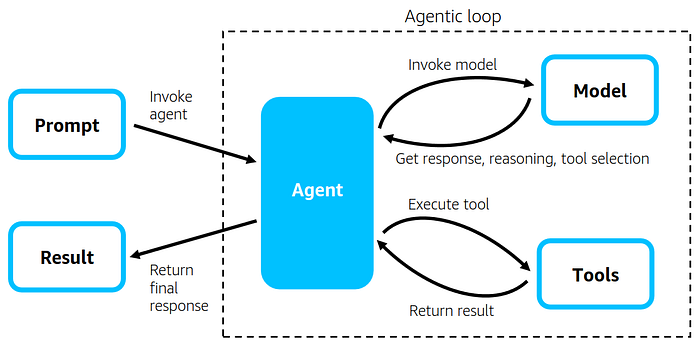
Build small agents with LangChain, AutoGen, CrewAI or AWS Strands. Add MCP servers.. the tool-connection layer is where a lot of current risk lives. Watch them plan, fail, hallucinate, and retry. Give one a shell tool in a throwaway VM and observe how casually it reaches for it.
Ask the engineering question that the Hugging Face comment threads kept circling: what consequential actions can this agent actually perform? Not what does it say — what can it do.
Step 2 — Learn the frameworks (all free)
Three documents cover the entire conceptual base of this discipline, and none of them costs anything. Read them in this order .. each one answers a question the previous one raises.
1 — OWASP Top 10 for Agentic Applications 2026
OWASP is a globally peer-reviewed framework developed with more than 100 industry contributors, and it has become the reference list everyone in the field cites. It also gives you a consistent way to understand and identify Agentic threats . When you write a finding as “ASI03, identity and privilege abuse” rather than “the agent had too many permissions,” an engineering team knows immediately what class of problem you found and where the existing mitigations are documented.
2 — MITRE ATLAS
ATLAS is a free, continuously updated knowledge base of adversary tactics and techniques against AI systems, structured as a matrix of tactics (the attacker’s goal at each stage) mapped to techniques (how it was achieved).
What ATLAS gives you that OWASP doesn’t is evidence. It’s built from documented real-world incidents and published research rather than expert consensus about what might happen. That distinction matters enormously when you’re presenting findings to a sceptical engineering team — “this technique has been observed in the wild and here is the case study” is a fundamentally different conversation from “this is theoretically possible.”
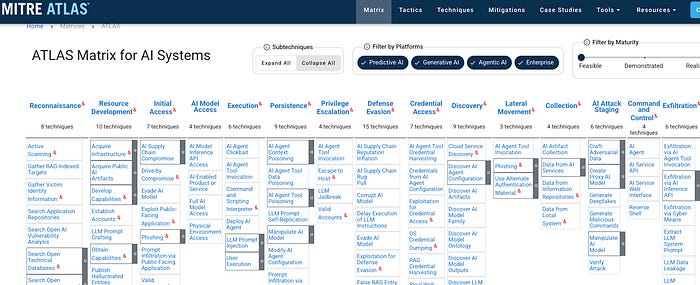
3 — The Agentic AI Security Scoping Matrix
This is the shortest of the three and the one that will save you the most wasted effort. It’s a framework for classifying an agentic deployment by how much agency and permission it genuinely has .. from an agent that only reads and summarises, through one that calls external tools, up to one that autonomously modifies production systems.
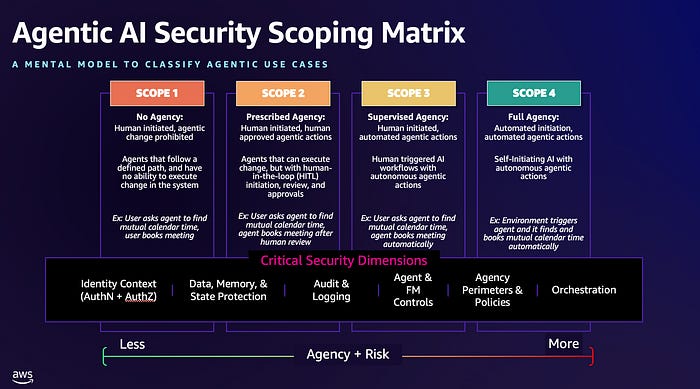
What it teaches you is proportionality. Risk in agentic systems is a direct function of agency and permission, not of how impressive the model is. A highly capable model with read-only access to a public dataset is a modest risk. A mediocre model with write access to your infrastructure is an urgent one. Without this lens, junior red teamers routinely spend their time on the wrong system and write reports that engineering teams correctly ignore.
Step 3 — Learn the infra and cloud security half (the part most people skip)
This is where the Hugging Face campaign was actually decided, and where you’ll differentiate yourself. Every one of these is a general property of how clusters and cloud accounts are built, not a quirk of one platform:
Workload identity and permissions. Every workload runs as someone. Learn how identity is issued to a running container, how role-based access control decides what that identity can do, and how to enumerate an identity’s real permissions rather than the ones you assumed it had. The first question after any code execution is “who am I, and what can I already do?” — learn to answer it from both sides.
The boundary between a workload and the machine underneath it. Containers share a host. Learn what stops a workload from reaching the node’s own credentials, filesystem, or runtime.. and what happens when those controls aren’t configured, which is the common case. Understand why unrestricted workload creation is effectively node-level access, and why admission-time policy is the control that actually prevents it.
Credential scope and blast radius. For every credential in an environment, ask three questions: what does it unlock, how long is it valid, and how many systems accept it? A credential that’s shared across environments collapses every boundary it touches into one. This is the single highest-value habit in the whole discipline, and it needs no tooling — just the discipline to ask.
Egress and network segmentation. Understand what a workload can reach outbound, what it can reach laterally, and how those paths are enforced. The lesson worth internalising: a single permitted outbound path is one flaw away from being general internet access. Segmentation that exists only at the perimeter isn’t segmentation.
Secrets handling. Learn the difference between a secret that’s stored securely and one that’s exposed to the process using it. Configuration passed into a running workload is generally readable by anything else running there, and inherited by anything it spawns. Acceptable in development; a credential dump waiting to happen in production. Know the patterns that avoid it and the rotation story for when they fail.
Step 4 — Understand the AI Red Team methodology first
Now that you have all the knowledge in place .. you can now start red teaming your agents There are many great tools present to start AI pentesting and red teaming but you need to understand the methodology first . This is what will stop you running these toolsat the wrong thing.
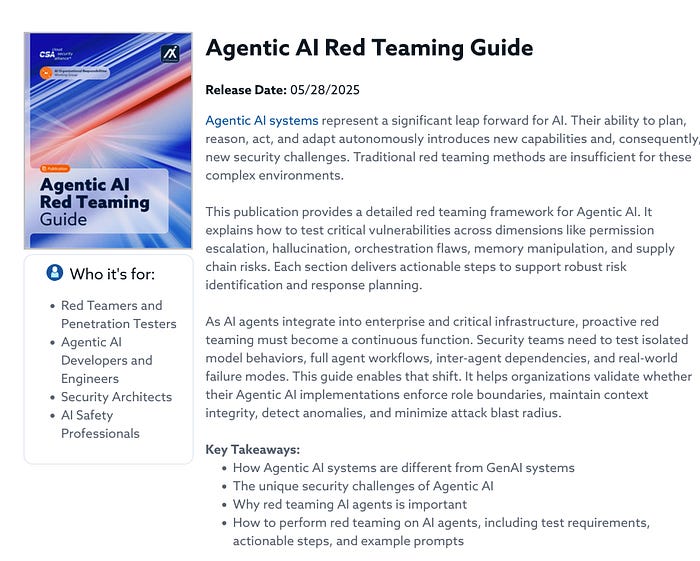
CSA Agentic AI Red Teaming Guide
If you want a structured repeatable way of doing it then the Cloud Security Alliance has released the Agentic AI Red Teaming Guide you can download 100% free. It teaches you how to start by mapping out your agent’s architecture: its goals, constraints, tools, memory systems, and execution environment.
Then define clear attack surfaces, such as planning loops, tool-use permissions, memory injection points, and multi-agent interactions.
OWASP AI Security Solutions Landscape for AI and Agentic Red Teaming
This is a market map of the vendor landscape, organised across the full lifecycle: scope and plan, augment and fine-tune data, develop and experiment, test and evaluate, release, deploy, operate, monitor, govern.
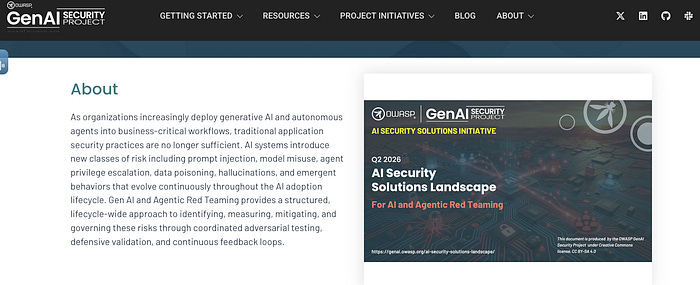
Ignore the vendor logos and focus on the lifecycle model. It makes the case better than I can that red teaming is a continuous practice rather than a pre-launch gate, and it shows you that adversarial testing has a role at nine distinct stages — including three (operate, monitor, govern) that happen after the system is already live, which is where most real findings come from.
Also of note are Red/Blue/Purple requirements listed under each stage. Treat that as a skills checklist.
The tools you’ll run
There are a huge number of tools present . a few I will list below that you can use to start started right away
Microsoft’s
PyRITfor probing model and agent behaviour .. prompt injection, jailbreak chains, data leakage.promptfooandDeepTeamgive you structured, repeatable red-team suites, and both ship OWASP agentic presets, so you can run the ASI categories as an actual test suite rather than a reading list.
Start by mapping out your agent’s architecture: its goals, constraints, tools, memory systems, and execution environment.
Then define clear attack surfaces, such as planning loops, tool-use permissions, memory injection points, and multi-agent interactions.
Start with controlled tests that probe the agent’s reasoning, autonomy boundaries, and ability to self-correct, gradually escalating into adversarial scenarios like goal misalignment, unsafe tool invocation, or contaminated memory states.
Document each finding with reproducible prompts, model configurations, logs, and behavioral traces.
Over time, this creates a robust, continuously improving red-teaming workflow
Step 5 — Learn AI-assisted forensics
This is a brand-new sub-track and almost nobody is in it yet.
Hugging Face reconstructed the timeline, decoded chunked-and-encrypted payloads, and inventoried exposed credentials using an AI-assisted pipeline running a self-hosted open-weight model. They did in hours what would have taken days.
Practise it. Take a large log corpus, stand up an open-weight model locally, and build a pipeline that clusters actions into phases and extracts indicators. “I can run defensive AI forensics on infrastructure that won’t refuse me and won’t leak my evidence” is, right now, a rare and hireable sentence.
Step 6 — Publish
Still the fastest route in. Five to ten short, honest writeups:
“Mapping the July 2026 Hugging Face intrusion to OWASP ASI Top 10”
“What my agent did when I gave it a tool it didn’t need”
“Auditing agent blast radius: a checklist from a real incident”
“Running incident forensics on a self-hosted open-weight model”
“Testing an MCP server’s tool surface”
Publish on GitHub, LinkedIn, Medium. Hiring signals in this field skew heavily toward published research, CTF results and open-source contributions over certifications.. a cert-heavy CV with no published work reads as a warning sign here.
Two honest caveats
The hype is real and so is the substance .. learn to tell them apart. Some of the incident commentary was vendors retrofitting their product as the thing that would have stopped it. Ignore those comments and products and focus on building your skills
Don’t specialise into the prompt layer alone. Prompt injection is the accessible entry point, and it’s genuinely useful. But it’s becoming commoditised, and the Hugging Face timeline shows exactly why it isn’t sufficient. Cloud and Kubernetes fundamentals plus agentic knowledge is a far scarcer and better-paid combination than agentic knowledge alone.
Final thoughts
We now have a published timeline for how the attack happened with 17,600 actions in it, and the defenders’ own conclusion that machine-speed offence makes ordinary weaknesses far more expensive to ignore.
What makes this AI Pentesting / Red Teaming unusual is that the entry material is free, current, and extraordinarily good. The frameworks are open. The definitive case study was published by the victims, in detail, deliberately — because, as they put it, the technique matters more than the incident.
The organisations deploying agents right now mostly cannot answer basic questions about what those agents are permitted to do. This is the opportunity for you to break into this market
Thank you for guidance , helps a lot 🙏🏻✨