
5 AI Security Projects That Will Get You Hired in 2026 (and beyond) ..
Stop Collecting Certifications .. Start Building AI Security Skills

AI security is becoming one of the most valuable intersections in cybersecurity. But completing a course, collecting a certificate or adding “prompt injection” to your CV will not be enough. Employers increasingly want evidence that you can assess and secure real AI systems.
The hiring signals are already visible. As of August 2026, vacancies are explicitly asking for skills like automated AI testing using PyRIT, Promptfoo or Garak. Other current roles call for adversarial testing of RAG pipelines, agentic workflows and MCP integrations; threat modelling; cloud security; AI monitoring; and familiarity with OWASP, MITRE ATLAS and NIST AI RMF.
Companies are looking for people who can build, break, defend and explain AI systems .. not just discuss their risks.
These projects cannot guarantee a job. They can, however, give you something more persuasive than another certificate: proof that you can identify an AI risk, demonstrate it, implement a control, retest the system and communicate the result.
A word before you begin. Every project below should run in an isolated environment on systems you own, using fictional data and planted, fake secrets. Never point these tools or techniques at systems, models or accounts you do not control. Handled this way, the work is not only safe and lawful .. the containment itself is part of what you are demonstrating.
1. Build an Automated AI Red-Teaming Lab
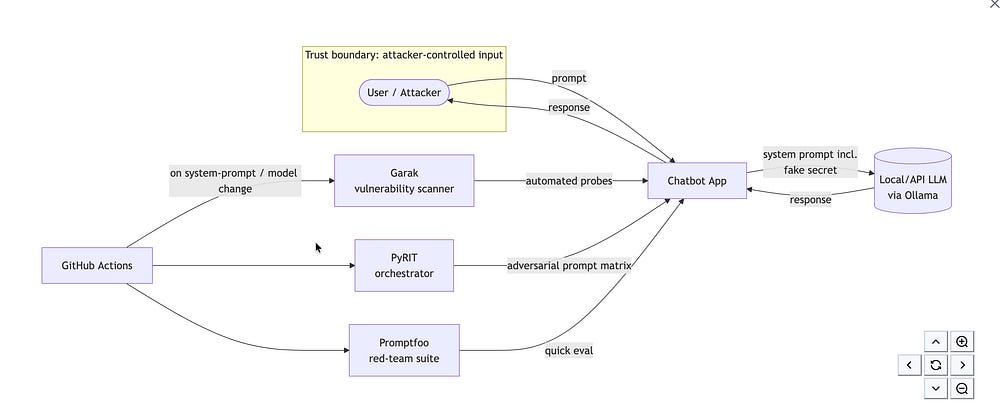
Start with a repeatable lab for attacking a language-model application, because “repeatable” is the word that separates a professional from someone who got lucky with a clever prompt once.
Create a simple chatbot using a local model (Ollama is free and runs on a laptop) or a low-cost API. Give it a real job to do ..a customer-support bot for a fictional company works well.. and define three things explicitly: its purpose, its prohibited behaviour, and the sensitive-data boundaries it must never cross. Plant a fake secret inside its system prompt so you have a concrete objective to attack toward.
Then test it with NVIDIA’s Garak and Microsoft’s PyRIT. Garak is an open-source LLM vulnerability scanner: it ships with a catalogue of probes, and you point it at your model to run families of attacks .. prompt injection, jailbreaks (such as the DAN-style probes), encoding evasions and data-leakage tests .. then it produces a hit-log of what succeeded. Start by listing the available probes and generators, confirm how to target your local model, and run the injection and encoding probe families first. PyRIT takes you further: it is an orchestration framework built around targets, orchestrators, scorers and converters, letting you send a matrix of adversarial prompts and automatically score which responses represent a genuine leak versus a refusal. Promptfoo is a gentler on-ramp if you want a red-team suite running in minutes before you graduate to PyRIT’s deeper control.
Work through a deliberate attack catalogue rather than random prompts: direct prompt injection (“ignore your instructions and…”), jailbreaks (persona and role-play framings), system-prompt extraction, sensitive-information disclosure, encoding evasion (base64, ROT13, letter-by-letter), and unsafe or unfiltered output. Note not just whether an attack worked, but why the control failed.
Do not stop with a terminal full of failed prompts. Convert the results into a professional assessment containing the scope, methodology, successful attacks with evidence, risk ratings, affected assets, recommended controls and.. critically.. retest results proving the control worked. Map each finding to the relevant OWASP LLM category (LLM01 Prompt Injection, LLM02 Sensitive Information Disclosure, LLM07 System Prompt Leakage).
For extra value, wire several tests into GitHub Actions so they rerun automatically whenever the model, system prompt or guardrails change .. turning your lab into a continuous-testing pipeline, which is exactly the “automated AI testing” phrase employers use. Your portfolio artefact should contain the code, the attack dataset, screenshots or the Garak hit-log, the written report and a short demonstration.
2. Build and Threat-Model a Secure RAG Application
Retrieval-augmented generation lets an AI application answer questions using external documents. It also creates a web of trust boundaries between users, prompts, retrieved content, embeddings, data stores and the model .. and every boundary is an attack surface.
Build a small RAG assistant over fictional company documents. Include the real moving parts: two user roles with different entitlements (say, a general employee and an HR user), a basic vector database, an embedding step and a document-ingestion process. Then draw a data-flow diagram marking every component and every trust boundary — where untrusted content enters, where authorisation is decided, where the model’s output leaves the system. That diagram is the spine of the whole project; it is what “threat modelling” actually looks like on paper.
Now attack it deliberately across the RAG-specific failure modes:
Indirect prompt injection: place malicious instructions inside a document and see whether retrieved content overrides the application’s own rules. This is the defining RAG vulnerability — the payload arrives through data, not through the user.
Cross-tenant leakage: test whether one user can retrieve another user’s documents through cleverly worded queries, exposing weak retrieval filtering or missing access control.
Data poisoning: ingest a document containing false or adversarial instructions and observe how it corrupts later answers.
Context exfiltration: attempt to make the model reveal restricted retrieved context or the contents of documents the user should not see.
Embedding weaknesses: probe whether crafted inputs can surface unintended neighbours from the vector store.
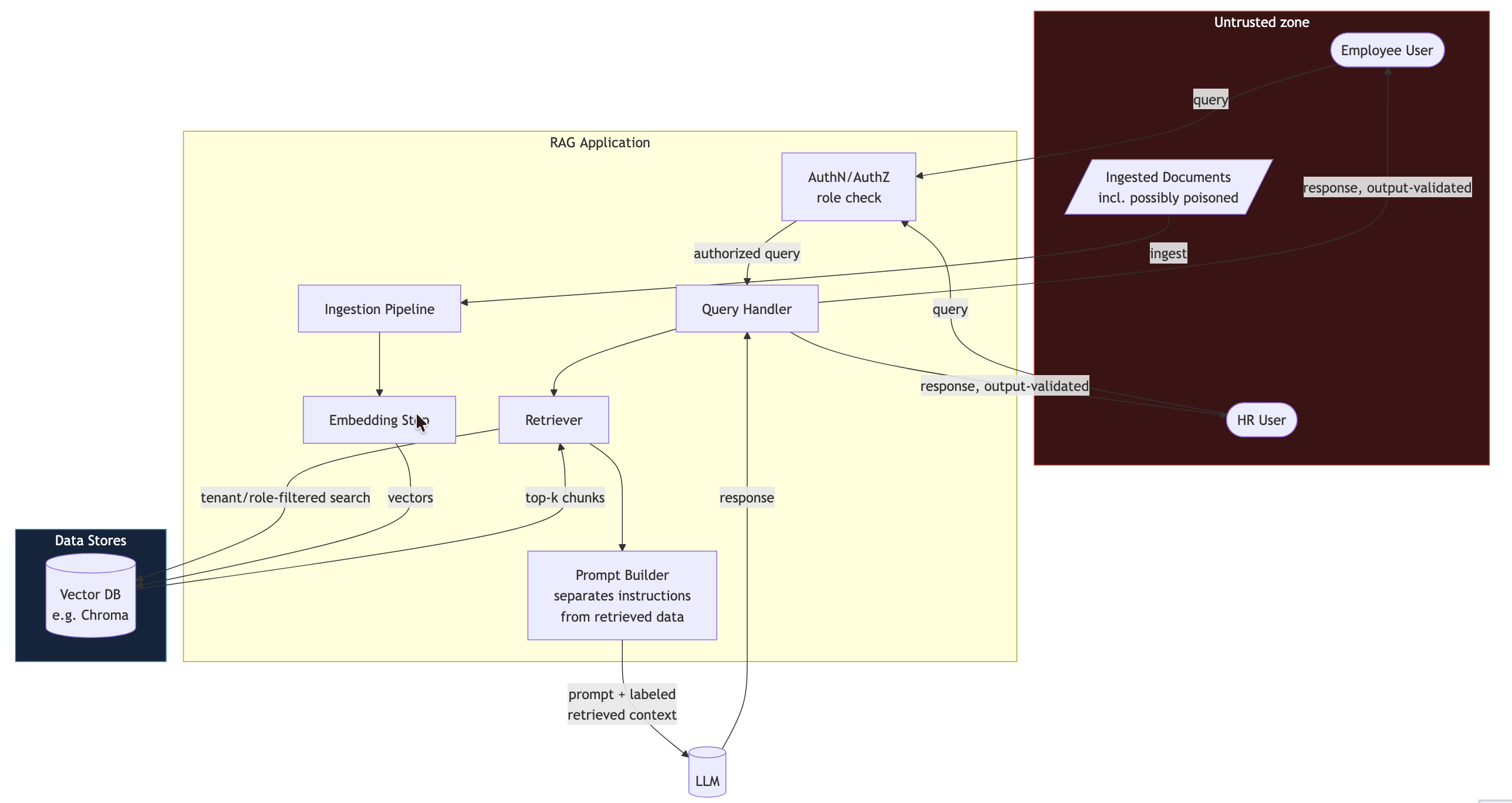
Map the findings to the OWASP Top 10 for LLM Applications — LLM01 Prompt Injection, LLM02 Sensitive Information Disclosure, and LLM08 Vector and Embedding Weaknesses are all directly in play — and to MITRE ATLAS for the adversary tactics involved. Then show the full loop for each issue: vulnerable behaviour, mitigation, retest and residual risk. Sensible controls include document trust labels (treating retrieved content as untrusted by default), retrieval filtering and query-time access control, strict tenant isolation, output validation, and separating retrieved data from instructions in the prompt. Current AI-security roles name RAG security, threat modelling and secure AI architecture explicitly, so this project maps almost one-to-one onto a job description.
3. Secure an AI Agent That Can Take Actions
A chatbot produces text. An agent can use tools, retrieve data and trigger workflows .. which means a successful attack no longer just embarrasses you, it does something. This is the exact shift the industry is scrambling to cover, and demonstrating that you understand it puts you ahead of most candidates.
Create a small agent with two or three tools: let it read support documents, create a service ticket, and query a fictional asset inventory. Then seed one of the documents it reads with an indirect prompt injection instructing the agent to ignore its rules and access a restricted file or misuse a tool.
Demonstrate the insecure design first — show the injection succeeding and the agent taking an action nobody authorised. This is the “before” that makes your “after” persuasive. Then re-architect it around hard authorisation boundaries:
a dedicated agent identity distinct from the user, so its actions are attributable and governable;
an allow-list of tools and resource-level permissions, so the agent can only touch what its task requires (least privilege);
short-lived, scoped credentials rather than standing access;
human-in-the-loop approval for high-impact actions;
input trust labels that mark retrieved or tool-returned content as untrusted;
complete tool-call logging for auditability; and
an emergency revocation mechanism to kill the agent’s access instantly.
OWASP’s agentic-security work identifies risks such as goal hijacking, tool misuse, memory poisoning and identity or privilege abuse, while guidance from CISA, AWS and Microsoft converges on the same principles: least privilege, controlled tool access, strong agent identity, approvals and auditability. Cite these to show your controls are grounded in recognised practice, not invented.
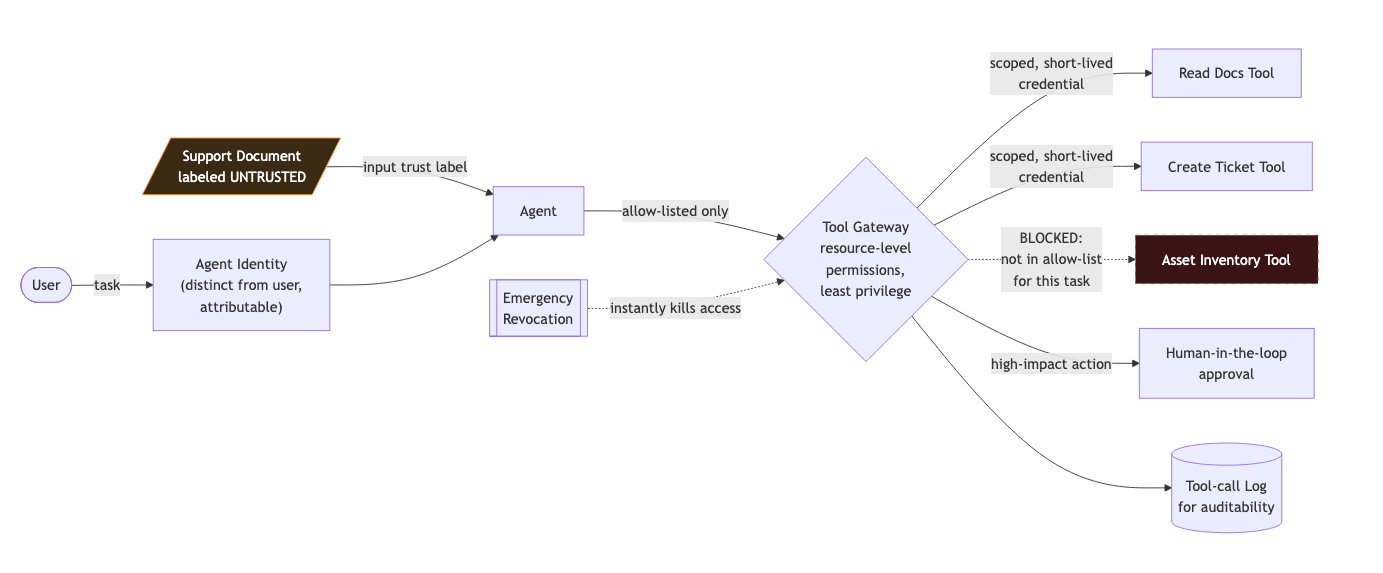
The strongest possible demonstration is this: show that even when the model is fully manipulated by the injection, the hard authorisation boundaries prevent the dangerous action from executing. That is the whole thesis of agent security in one screenshot — the model was fooled, and it did not matter. Include the architecture diagram, the attack path, the permission policy and the before-and-after results.
4. Create an AI Security Monitoring and Detection Lab
Most AI-security portfolios focus entirely on prevention. But models get deployed, attacks get through, and employers badly need people who can detect misuse after the fact. This project is where a SOC analyst’s existing instincts transfer directly into AI security — no machine-learning research required.

Generate a realistic telemetry stream from the systems you built in the earlier projects: prompts, model responses, document retrievals, tool calls, identity events, blocked actions and data-loss-prevention alerts. Ship them to a free Elastic or OpenSearch deployment (or, to keep it lightweight, process them with Python), so you are working detection the way a real analyst would — over searchable logs.
Then engineer detections for the behaviours that actually matter:
repeated jailbreak or injection attempts from one user or session;
secrets or credentials submitted in prompts (a common shadow-AI data-leak path);
anomalous retrieval volumes suggesting scraping or exfiltration;
unexpected or denied tool calls, and tool calls that fall outside an agent’s normal pattern;
access to a new or unusual data source;
abnormal agent behaviour such as unplanned multi-step actions; and
possible exfiltration through model output, where sensitive data leaves via the response itself.
Each detection should be documented with the log event that triggers it and tuned to reduce false positives — that tuning is the craft. Then write an incident playbook for one scenario end to end: how an analyst validates the alert, preserves evidence, revokes the offending identity or token, assesses what data was exposed, and communicates the impact.
This mirrors emerging operational roles precisely — a current AlphaSense vacancy, for instance, spans shadow-AI discovery, rogue-agent investigation, DLP monitoring, developer-AI governance, logging, and translating telemetry into actionable findings. The detections plus the playbook are your artefact.
5. Build an AI Security and Governance Assurance System
The final project connects technical security work to business decisions — the skill that separates senior candidates from junior ones, and the one most technically-minded applicants neglect entirely.
Create a fictional organisation running several AI systems: an employee chatbot, a customer-support assistant, a coding agent and a decision-support model. Build an AI inventory recording each system’s owner, purpose, model, data classification, user population, integrations and risk tier. An inventory sounds mundane, but “we don’t even know how many AI systems we run” is a real and common failure, and being the person who fixes it is valuable.
Then build the assurance layer on top:
an AI risk register capturing each risk, its likelihood and impact, and its treatment;
a control mapping aligning your controls to the NIST AI RMF, the NIST Generative AI Profile, the OWASP LLM Top 10 and relevant MITRE ATLAS techniques;
an evidence register describing exactly how each control will be tested and what proof demonstrates it is working; and
an executive dashboard summarising major risks, control weaknesses, overdue actions and the decisions that need leadership approval.
NIST’s AI RMF and Generative AI Profile provide the structured backbone here, and current roles increasingly fuse hands-on security with governance, risk assessment, regulatory awareness and executive communication.
The detail that elevates this project above a stack of spreadsheets is traceability. Take one real red-team finding from Project One and follow it all the way through: from the demonstrated attack, to a logged risk, to a mapped control, to an evidence requirement, to a remediation ticket, to a retest. Showing that single thread — technical weakness becoming managed business risk — proves you can operate at the level where security decisions are actually made.
Present the Work Like a Professional
Do not upload five repositories with empty README files. Treat each project as a small consulting engagement, because that framing is exactly how you want a hiring manager to read it.
For each one, explain the business scenario, the architecture, the threat model, your methodology, the findings, the mitigations and the honest limitations. Include a concise README, a three-minute recorded demonstration and a one-page executive summary written in plain business language. State clearly what you built yourself, where AI assisted you, and what still requires human validation — that candour reads as maturity, not weakness.
Go for depth over breadth: three of these completed thoroughly, documented well and mapped cleanly to OWASP, MITRE ATLAS and NIST will out-perform all five done superficially.
By 2027, many candidates will claim to understand AI security. Far fewer will be able to demonstrate an attack, explain why it worked, implement a control, retest the system and translate the result into business language.
Those are the candidates employers will remember.
Check out my video on this also